
Are You Building a Tricycle?
A Facilitation Fallacy about safety wheels, scaffolding, and the need to wobble
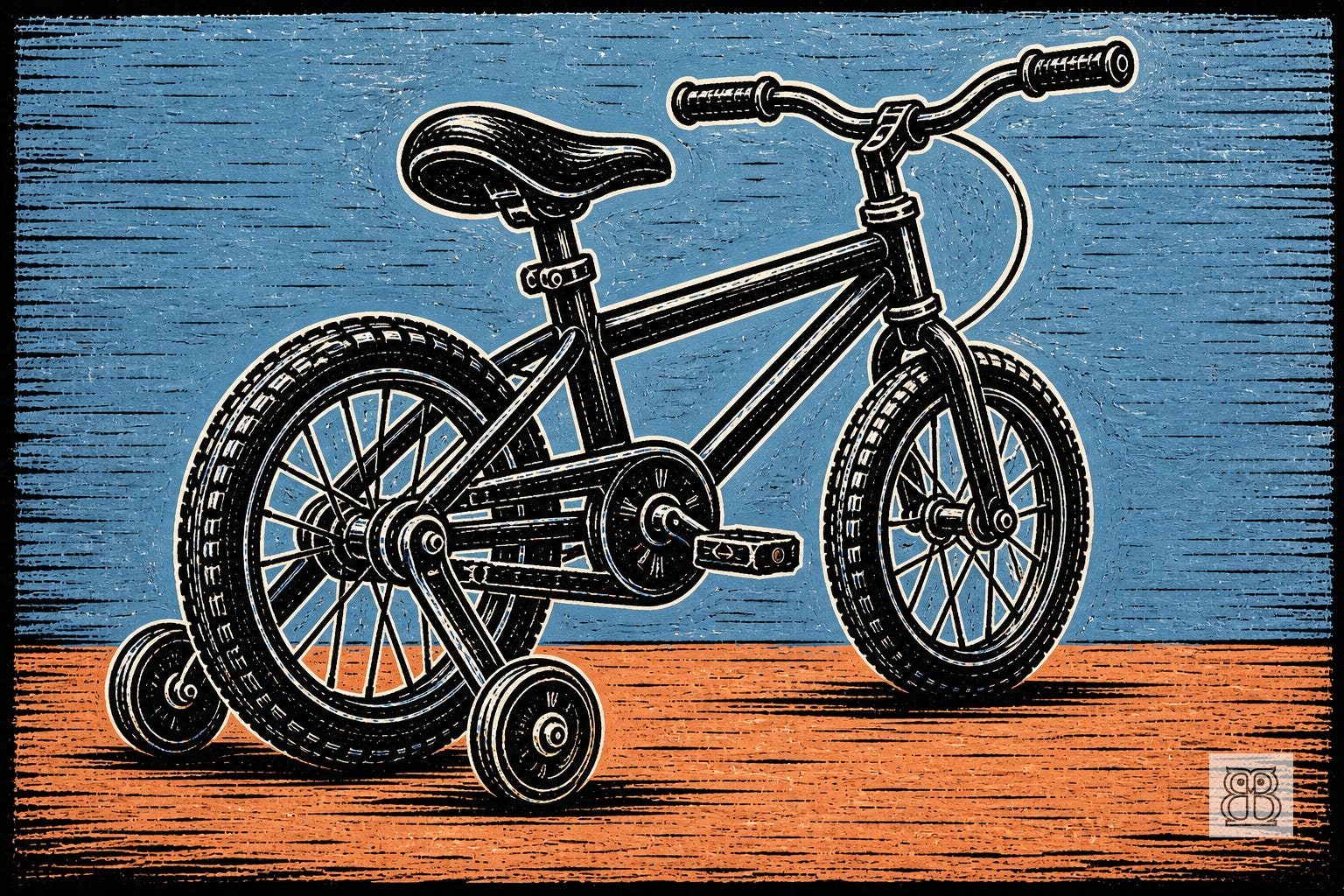
A child is learning to ride a bicycle. The parent, understandably nervous, fits stabilisers. But instead of setting them a centimetre off the ground, where they’ll catch the worst of the wobble without preventing the wobble itself, they lower them until both wheels sit flush on the tarmac. The bike is now, mechanically speaking, a tricycle. The child pedals to the end of the street and back, beaming. The parent beams back.
Nobody has learned to ride a bicycle.
THE WORD ‘SCAFFOLDING’ entered educational vocabulary in 1976, when Wood, Bruner, and Ross used it to describe the temporary support that helps a learner accomplish something they couldn’t manage alone. It caught on, understandably. The image is clean: a temporary structure, external to the building, removed when no longer needed. Vygotsky’s zone of proximal development had already established that learners can achieve more with assistance than without; Wood et al. gave practitioners a vivid way to picture what that assistance might look like.
I would like to stay on the building site for a moment, because the metaphor deserves more scrutiny than it usually gets. Construction scaffolding gives workers access. It gets them to the right floor, the right wall, the right height. Once there, they still have to lay the bricks. The scaffolding never touches the building. It doesn’t shape the structure, bear any of the load, or leave a trace once removed. The building stands independently because the building was always doing the standing.
So far, so applicable. But buildings don’t claim to learn anything from the scaffold. And that’s where the metaphor starts to mislead.
When Access Becomes Achievement
There is a version of scaffolding that works the way it should. It positions the participant to encounter the difficulty, without removing the difficulty. A reframed question. A constraint that makes the problem tractable. A role or a frame that gives a group permission to explore territory they’d otherwise avoid. Think of how Boal’s image theatre scaffolds complex political discussion by removing the pressure of verbal articulation. It is still challenging - indeed the scope of political discussion is often widened - but the mode of access is potentially more inclusive.
But there is another version. This is the scaffolding that doesn’t give access to the learning but access to the achievement, jumping clean over the learning to get there. Worksheets that funnel toward a single right answer. Discussion parameters so tight they predetermine the conclusion. Devising structures so prescriptive that the participants are assembling rather than creating. Hot-seating questions so leading that the character has nowhere to go but where the facilitator wanted them.1 The participant completes the task, the facilitator records the completion, and nobody notices that the skill which was supposed to develop in the doing of the task was designed out of the doing.
This is the fallacy. The facilitator believes they are using scaffolding to enable learning. What they are actually doing is enabling the appearance of learning. The task gets completed. The outcome looks right. The thinking, the struggle, the meaning-making all happened in the scaffold rather than in the person, with the structure quietly preparing a world for the participant instead of preparing the participant for the world.
The Stabiliser Test
The construction metaphor is too static to capture what goes wrong here. We need something where the learner is actively involved, where their body (or mind) has to do something, and where you can see the difference between genuine and simulated engagement. The stabiliser on a bicycle is closer.
Stabilisers set correctly, a centimetre or so off the ground, change the stakes without changing the task. The child is still balancing: making micro-adjustments, experiencing the wobble. The stabilisers mean that when the wobble wins, the consequence is a jarring clunk rather than a grazed knee. The learning is happening in the body of the rider, not in the apparatus.
Stabilisers set flush to the tarmac change the task entirely. The physics of balance, the actual thing that needs to be learned, has been bypassed. And the child could ride like that for years without ever learning to balance, because the conditions for learning it have been engineered out of the experience.
The removal moment tells you everything. If the stabilisers were at the right height, taking them off is a minor transition. Wobbly, perhaps, but the skill was already developing. If they were on the ground, taking them off isn’t a transition. It’s a crisis. The skill was never being practised.
The diagnostic question for any piece of scaffolding, then, is straightforward: have I set the stabilisers just above the ground, or flush to the tarmac? Is this a bicycle with insurance, or a tricycle with pretensions?
The Drift Toward the Tarmac
The trickiest version of this fallacy isn’t the one committed out of ignorance. It’s the one that develops gradually, through experience, when a conscientious facilitator unconsciously lowers the stabilisers over time.
It works something like this. You run an exercise or a project for the first time, and some participants make choices that don’t work. They pick a devising stimulus that leads nowhere. They attempt a scene structure they can’t sustain. They misread the demands of the task. This is, of course, exactly what is supposed to happen. The less useful choices are the learning. Choosing and then having to reckon with the consequences is how you develop the judgment to choose more wisely next time. But it doesn’t feel like learning at the time. It can feel like a session going wrong.
So the next time you run it, you quietly remove one of the options that caused trouble. You narrow the brief. You steer a little more firmly in the setup. The session runs more smoothly. The outputs are better. The participants are happier. You are happier. And the following year you narrow it a little further. Each individual adjustment is small and sensible. None of them feels like you’re removing the learning. But over two or three cycles, you’ve incrementally replaced a bicycle with a tricycle.
I came face to face with this running a degree course. After a couple of years I realised I was starting to unconsciously remove the possibility of ‘bad’ choices in certain areas rather than addressing the students’ ability to make better ones. The outputs were cleaner. The module evaluations were friendlier. But the graduates were less equipped for the mess of professional practice, where nobody narrows the brief for you.2
This is where metrics accelerate the drift. Participant satisfaction surveys reward smooth sessions. League tables and quality frameworks incentivise consistent outcomes. Observation criteria only registers visible evidence of progress. All of these exert a gravitational pull toward lowering the stabilisers, because the wobble, which is where the learning lives, registers as a problem in pretty much every measurement system we have. Goodhart’s Law applies: once the metric becomes the target, you start optimising for the metric. And the easiest way to optimise for smooth, consistent, visually impressive sessions is to scaffold out the difficulty.
Recognising the Tricycle Fallacy
The hardest thing about this fallacy is that it looks like good practice. The task was completed. The participants were engaged. The devised piece had a clear structure. The discussion reached a resolution. The session ran to time and nobody looked confused.
But consider what happens when the scaffold is removed. If, at that point, the participant cannot do what they appeared to do during the scaffolded activity, the scaffold was not a bridge. It was a bypass.
Could a participant get through this exercise without understanding why it works? Could they complete the devising task by following the template without making any genuine artistic choices? Could they ‘pass’ the character hot-seating by giving the answers the questions were designed to extract? If yes, the stabilisers are on the ground.
Potential Consequences
Pseudo-achievement. Participants believe they have accomplished something they have not. The facilitator’s records confirm the illusion.
Nothing you didn’t expect. When the scaffold predetermines the route, you always arrive where you expected. But so does everyone else. The devised scene that takes an unexpected turn, the discussion that surfaces something nobody anticipated, the moment where a participant’s choice reframes the whole exercise - none of these can happen when the only available choices are the ones you built in. You get consistency. You lose discovery. And discovery, more often than not, is where the most important learning was hiding.
Fragile confidence. Confidence built on scaffolded success doesn’t survive contact with un-scaffolded reality. The participant, having never practised balance, blames everything but themselves for falling.
Dependency. Participants learn to wait for the structure rather than generating their own. The scaffold, intended as temporary, becomes permanent because nothing has been built that would survive without it. The stabilisers never come off.
Ways of Interrupting the Fallacy
Distinguish the task from the development. Before building scaffold, be precise about what opportunities the participants should have for development, not just what they’re supposed to produce. Then check: does the scaffold preserve the learning challenge, or bypass it on the way to the product?
Design for the wobble. Effective scaffolding doesn’t prevent difficulty; it manages the consequences of difficulty. What is the equivalent of the clunk (not the grazed knee) in this exercise? In a devising process, it might be a dull scene that the group can reflect on and rework, rather than a structure so tight that failure isn’t possible. The point is to make it safe to struggle, not impossible to struggle.
Shift the ratio over time. If the exercise requires three choices, the facilitator might build two into the structure and ask the participant to make one. Next time: the facilitator builds one in, the participant makes two. Eventually, the facilitator restricts the range of choices but the participant chooses within that range. The direction of travel is always toward the participant carrying more of the weight. If you can’t see where the ratio shifts in your plan, the stabilisers may be stuck.
Test by removal. Imagine stripping the scaffold out. If the exercise collapses entirely, you may have built a tricycle. If the exercise becomes harder but remains possible, you’ve probably set the stabilisers at the right height.
Audit for drift. If you’ve been running the same exercise or project for several cycles, compare the current version with the original. What choices have you removed? What options have you narrowed? Were those changes in response to genuine problems, or were they in response to the discomfort of watching participants wobble?
Always an Error?
Not always. Early encounters with unfamiliar material sometimes need the facilitator to carry more of the weight. A tightly structured exercise can serve as a stepping stone, provided the facilitator knows it’s a stepping stone and has a plan for raising the stabilisers. A group encountering forum theatre for the first time probably needs a more prescribed structure than one with experience of the form.
The error is not in building scaffold. It’s in mistaking the scaffold for the building. The question is not whether you’ve built a tricycle today, but whether you need to raise the stabilisers tomorrow.
To cite this article
Burns, B (2026) Are You Building a Tricycle? The Philosophical Theatre Facilitator: www.philosophicaltheatrefacilitator.substack.com
© Brendon Burns 2026
Sources:
Wood, D., Bruner, J.S. and Ross, G. (1976) ‘The Role of Tutoring in Problem Solving’. Journal of Child Psychology and Psychiatry, 17(2), pp. 89-100.
Even the facilitator’s facial expressions indicating a preferred choice!
Interestingly whilst setting the stabiliser a little higher was not popular at the time (particularly for the few that arrived on a tricycle) it actually led to greater satisfaction in the long term.