

TIME FOR ANOTHER ETYMOLOGICAL EXCURSION! This month I'm going to see where some digging into the origins of the word “Participation” leads us. It's a ubiquitous term in our field. It's what we hope for in our sessions and rehearsals, funders want us to measure it (even if they can't define it !), and I imagine it's in many of your job descriptions, if not your actual job title!
At first glance it's fairly straightforward. To participate (verb) is to take part in something. A person who takes part in an activity, a workshop for instance, is a participant (concrete noun). The behaviour of taking part is therefore known as participation (abstract noun). Etymologically, we're heading back via Old French (participacion) to the Latin participāre. This, in turn, is rooted in the Latin particeps - "having a share in, a sharer, accomplice". It is also worth noting that “part” (partem in Latin) has a lineage going right back to Proto-Indo-European pers - to exchange.
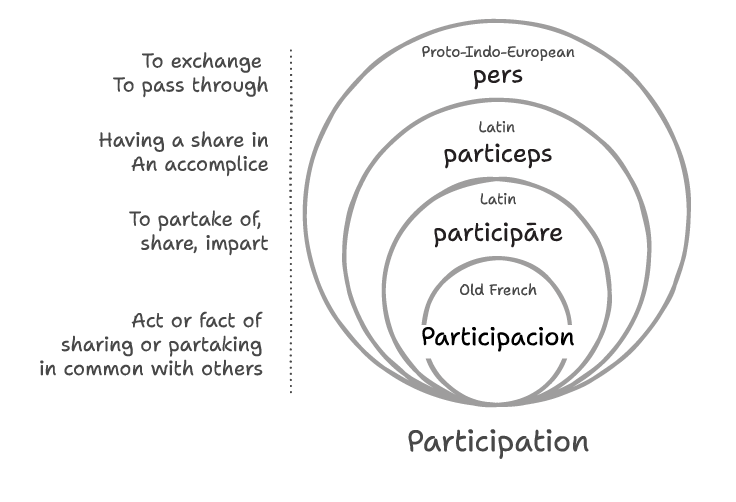
What you might notice here is the interplay of doing and receiving built into the origins of the word. In common usage, the 'doing' sense - joining in - is prevalent. The other perspective, participating as a form of receiving - sharing in - is perhaps less familiar.1
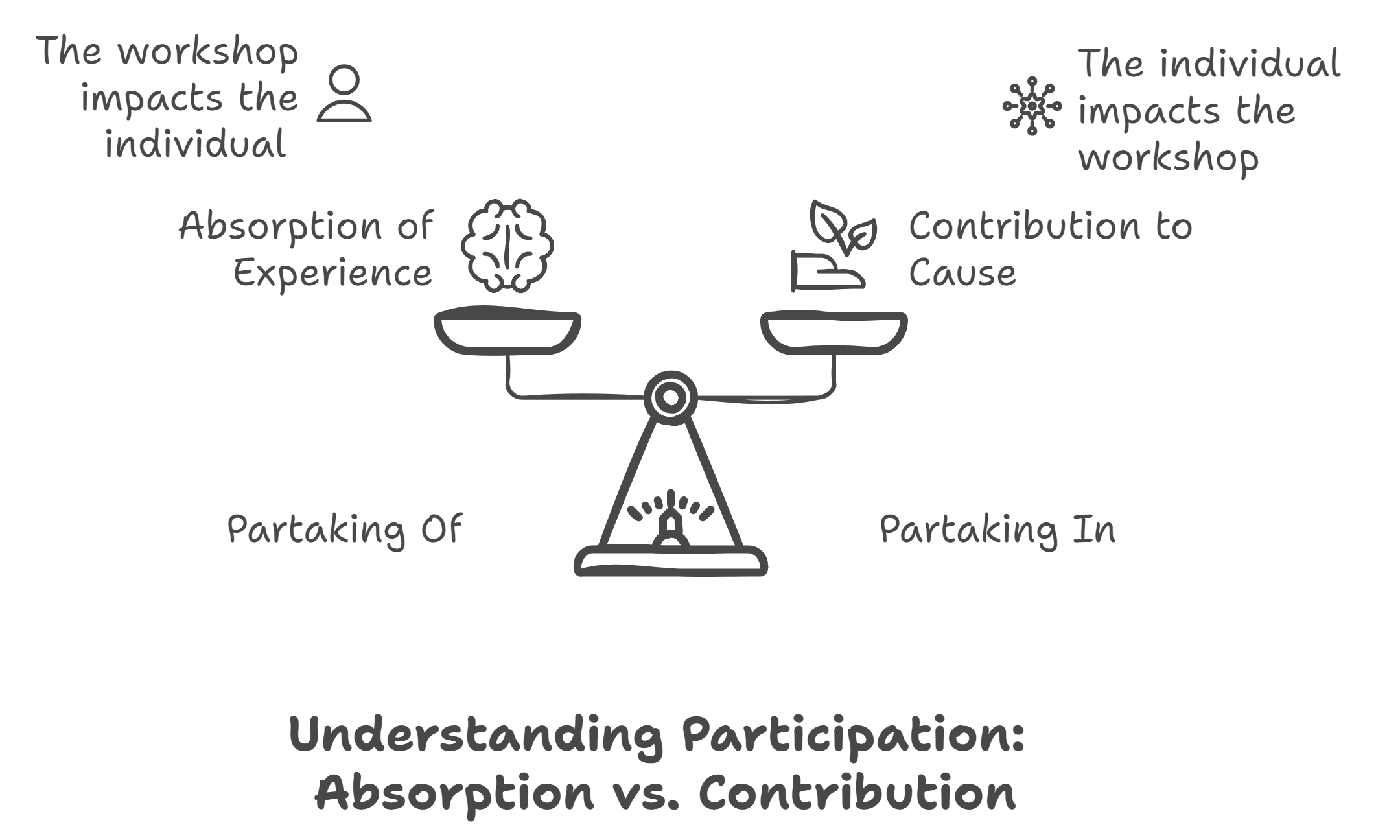
But what if we take this double meaning and run with it? What if participation might be said to involve reciprocity, a share in the effort and a share of the benefit. This is the position David Bohm takes in On Dialogue (1996). Bohm posits a distinction between 'partaking of' and 'partaking in.' In the former, somewhat archaic, phrase we might refer to 'partaking of' a shared meal, a set of beliefs, or perhaps even some form of spiritual communion. There is some 'other' thing that becomes part 'of' us - we absorb it. With “partaking in” the focus is on contribution or action. We might 'partake in' antisocial behaviour, the search for a missing child, or efforts to secure justice in society. Significantly, we don't do it alone. We become part of some 'other' thing outside ourselves. There is an interesting mirroring of the prepositions here. When we partake of, we take part of something in, but, when we partake in, we become part of something. Twisty word games aside (and feel free to ignore the last), the key point is that the surface level interpretation of participation as 'joining in' hides a potentially more holistic purpose, which could ultimately lead to a blurring of subject and object relations and the creation of a true 'commonwealth'.
Consider a forthcoming workshop, class, or rehearsal. What would good participation look like? Full attendance? Volunteers aplenty? Lines already learned? Lots of hands up? Now on face value, using the day-to-day interpretation of participation, this would probably count as good. The group 'joined in'. They participated. Or did they?
I write this newsletter from various coffee shops, imagining I'm chatting with you. If you ever find an article particularly helpful or thought-provoking, you can now literally buy me a coffee to fuel the next edition. This helps keep the newsletter free and accessible for everyone.

Pseudo-participation and Presence as participation
For a start, without more information it's very difficult to make a claim of absorption, partaking of, from this description. It might look as if individuals are 'contributing', but can we tell if it's participation or just compliance? I'm sure we've all worked with participants who follow instructions, make suggestions, always volunteer and yet only ever repeat what they think we want to hear - their aim is to be 'good'. As a result we are left with a kind of 'pseudo-participation'. It looks and sounds like the real thing, but there is neither absorption nor contribution, beyond a 'performance' of participation.2 Everyone leaves the session exactly the same as when they came in.
It is tempting to blame this on the 'system.' Certainly, a focus on learning for assessment - learning to say what the teacher/examiner 'wants to hear' - actively encourages pseudo-participation. However, it is also very easy to bake pseudo-participation into the structure of the workshop. We might not even realise we are doing it. Every time we offer the group a choice, but it's clear what our preferred option is, that's pseudo-participation. When a piece of TIE forum theatre only moves forward when the facilitator's solution is reached, pseudo-participation again. Essentially any plan that predictably processes the group's input is pseudo-participation.
By another measure, merely being there might count as participation. Good or bad? It depends. This is not at all uncommon as an evaluation metric, perhaps understandably so. We must also acknowledge that for some, simply getting through the door, and staying, is no small achievement. But, this last example aside, if presence counts as participation at a group level what are the group 'taking part in'? The quest for evaluation form content? Meeting the monthly fees target?
In fact, Bohm's partaking of / taking part in distinction can work as a useful 'razor' here - a cognitive shortcut. In both cases whilst there is an element of contribution, the absence of absorption renders the workshop a performance or demonstration of participation. Notably, everyone leaves exactly as they were when they came in, albeit with a sense of having been culturally/ pedagogically deodorised. Having failed to 'partake of' nothing has changed though all, including the facilitator, temporarily smell better!3
Passive participation and Slactivism
Let's take a look at the other end of the scale - the participant who 'partakes of' (absorbs / shares in), but resists fully becoming part of the workshop (contributing / joining in).
Imagine a group member who, whilst committed to their own achievement, sees no overlap with the interests of the group. “That's not what I came for” they seem to say - whether in reference to a specific exercise or when having to accommodate the needs/desires of other members of the group. This is a kind of passive participation - engagement with the content but only on terms exclusively suited to perceived self-interest. It's a dynamic that has become more prevalent in Higher Education over the last few years, and seems to be creeping into some Youth Theatre work.4 This is one of the more concerning variations of unbalanced participation. When we 'take part in' we participate in something beyond ourselves. Without this external object of participation, though, we view all others, including the facilitator, as 'participants' in the act of 'us'. It's a subtle type of solipsism that can be hard to spot (and can affect facilitators and group members equally). The Solipsist might leave the session changed5, but their presence has contributed little or nothing to others.
Without an external object of participation we view all others, including the facilitator, as 'participants' in the act of 'us'.
Lastly, there is another type of 'being present is enough' participation. Here attendance is not a cipher for contribution but instead a means of absorbing the kudos associated with the activity. For this individual, being in the room is seen as a sufficient, rather than merely necessary, criteria for claiming memberships status. In many ways it parallels 'Slactivism', the derogatory term given to those who present themselves as 'activists' but only ever send emails or tweets eschewing physical commitment. For us, this might be the cast member who always comes late and unprepared but is the first to suggest getting production hoodies. Or it could be the person that never puts themselves into anything strenuous or challenging, all the while posting 'arduous life of the artist' selfies on Instagram.
Deficit or blockage?
These may be extreme examples, and it's easy to interpret extremes negatively. The distance between the outlier and the majority can appear as a gap or deficit. It can feel like 'this individual is here and the rest of the group are there' or 'this group is a nightmare and all my other classes are fine.' The reality is likely far less polarized and more like a continuum, a sliding scale rather than an either/or. The key, I think, is to remember that even if someone is only 'partaking of' or only 'partaking in,' it is still a step towards full participation. Indeed, some of these behaviours may be legitimate misunderstandings or misapprehensions of what participation can be. Given the various cultural, social, and economic norms influencing our sessions, it's no wonder that individuals, or even entire groups, sometimes prefer absorption to contribution, or vice versa. Don't forget, we may well be doing the same ourselves.6
The Workshop as Manifold
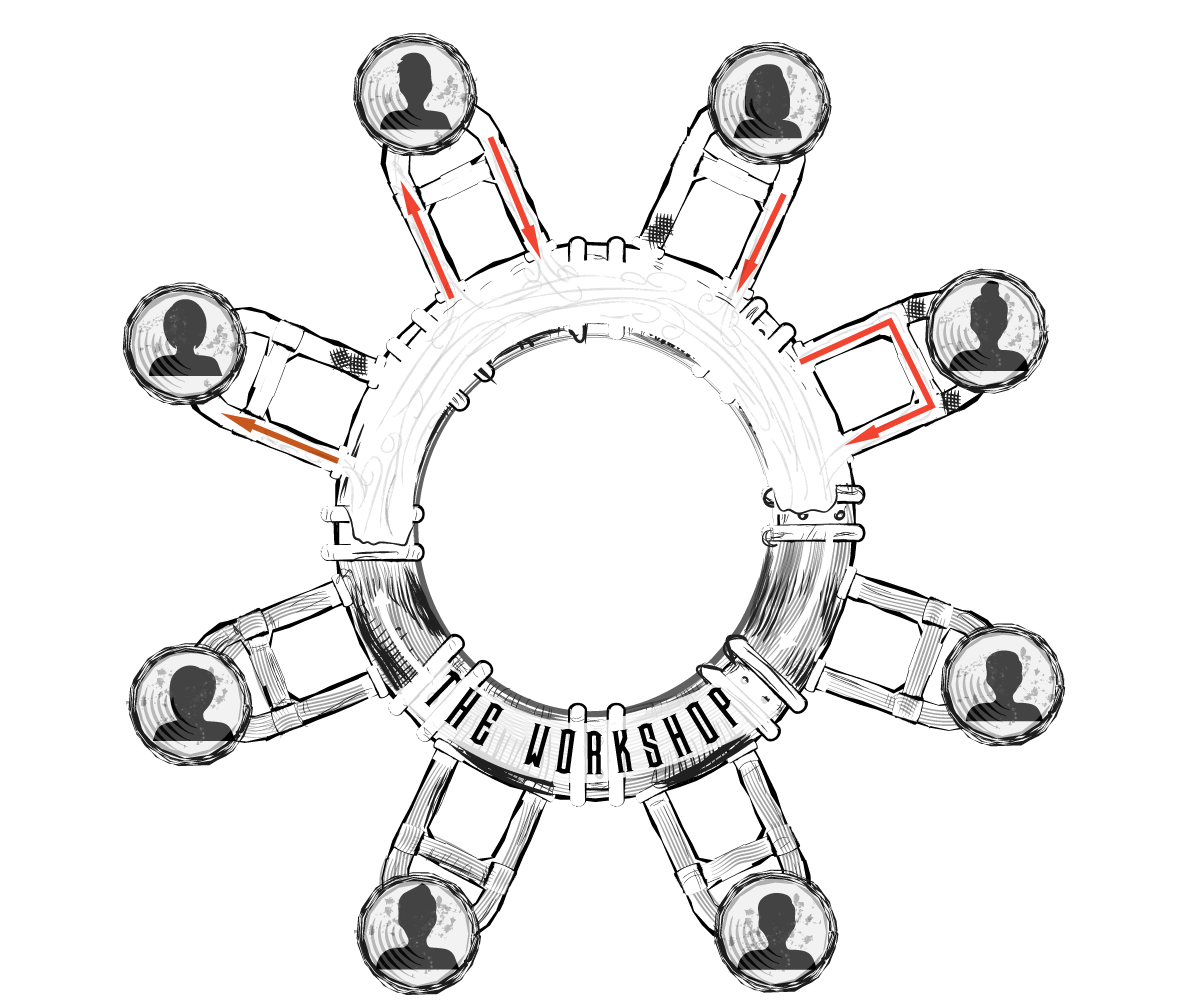
The diagram above envisages a number of participants in a workshop each with a capacity to partake of (let the workshop in) or partake in (add to the workshop). The first thing to notice is that the ‘the workshop’ only exists at the intersection of the actions of the participants and the facilitator. It is neither independent of them nor dependent on any specific individual.
Following the logic of the 'plumbing' participants can:
(a) absorb input from the workshop (partake of / share in),
(b) contribute to the workshop,(partake in / join in)
(c) let the workshop bypass them, or
(d) make no connection at all.
As already discussed, authentic participation involves both partaking of (a) and partaking in (b) - this keeps the workshop flowing. But there is no reason why everyone should be doing both all the time. My instinct is that we constantly switch valves and each participant might be switching at different times. Sometimes you might be full of ideas or willingness to challenge yourself, at other times you may need a moment to let things sink in before turning them into a contribution. One of the functions of the facilitator is to use their own participation to compensate for the ebbs and flows that result from this. And if the workshop is losing flow, pressure, volume (or other vague plumbing metaphor) then it is not a matter of something missing - a deficit in the participant - but instead evidence of some type of blockage. It's not our job to dissemble and 'fix' the participant. Blockages can be cleared by the workshop itself. It may take several cycles, but it can be done.
Unblocking Participation
So what, then, lies within the power of the facilitator, director, or teacher to promote a balanced cycle of participation?
If the blockage is one of surface compliance or pseudo-participation, consider the following:
How might you create a dynamic of horizontal relationships. Maintaining professional authority but not positioning yourself as the arbiter of all knowledge?7
Avoid personal praise (I loved how you did that) or direct advice (do it like this) and focus on feedback (the narrative was very clear there) and questions (how might you make the story clearer)
Be careful of shortcuts / hacks that allow participants to achieve without the opportunity of understanding how or why.
Problematise / make strange - highlight or bring awareness to contradictions in familiar or taken for granted concepts (Why do we pretend the audience isn't there? Can you actually own land?).
Each of these suggestions is aimed to bring focus to the content of the workshop and away from concerns to "do it right."
If, on the other hand, the concern is with a lack of 'partaking in' or contribution beyond the self then these ideas might help to get the flow back:
Plan warm-ups that help create a sense of shared identity - what Emile Durkheim called "Collective Effervescence." - the excitement and unity that arises when individuals come together for a shared purpose. This can be heightened with exercises that feature:
High physiological arousal (high energy)
Elements of synchrony - rhythmic movement, chanting or singing.
Look for opportunities to build moments of connection or pride. Both of these require space to recognise something has come into being that was not there before. This might be a scene, the group's ability to co-operate, or a shared insight or understanding.
Enable genuine inquiry - focusing on problem-posing rather than 'banking'.8 Importantly, both facilitator and participants should be co-intent on pursuing the goal. Passivity is inevitable if there is a sense the facilitator already knows the outcome.
Unblocking is a fundamentally practical task, to be undertaken undertaken at workshop level. We might recognise and implement small measures that will help specific individuals, but ultimately there are too many factors influencing participation that are beyond our control. Again, it is not our job to 'fix' individuals, but by creating dynamic spaces that foster both types of participation, we provide space for participants to grow on their own terms.
To finish with my customary etymological caveat - digging into the origins of words is not an exercise in control. The aim is not to argue for the correctness or truth of any specific usage. I urge no-one to wield etymology in self-righteous, anger to smugly tell their frenemy that they are wrong! The aim is to provide a moment of pause, encouraging us to reflect on something we might often take for granted.
If you have an idea for an etymological excursion do let me know in the comments.
To cite this article:
Burns, B (2025) From Joining In to Sharing In. The Philosophical Theatre Facilitator: www.philosophicaltheatrefacilitator.substack.com
© Brendon Burns 2025
Sources:
Bohm, D. and Nichol, L., 1996. On dialogue. London: Routledge.
Freire, P., Macedo, D.P. and Shor, I., 2018. Pedagogy of the oppressed. 50th anniversary edition ed. Translated by M.B. Ramos New York: Bloomsbury Academic.
Jackson, J.C., Jong, J., Bilkey, D., Whitehouse, H., Zollmann, S., McNaughton, C. and Halberstadt, J., 2018. Synchrony and Physiological Arousal Increase Cohesion and Cooperation in Large Naturalistic Groups. Scientific Reports, 8(1), p.127. https://doi.org/10.1038/s41598-017-18023-4.
Lewis, C.T., 2020. A Latin dictionary: founded on Andrews’ edition of Freund’s Latin dictionary. Chapel-en-le-Frith: Nigel Gourlay.
Shilling, C. and Mellor, P.A., 1998. Durkheim, Morality and Modernity: Collective Effervescence, Homo Duplex and the Sources of Moral Action. The British Journal of Sociology, 49(2), pp.193–209. https://doi.org/10.2307/591309.
One exception to this , although still rather niche, is "participation in profits" to refer to the percentage of revenue an actor or creative receives from a film. Most famously, Sir Alec Guinness took a smaller fee for Star Wars in exchange for "participation". The rest, as they say, is history, or if you're one of the beneficiaries of Guinness' estate the rest is royalties!!!
Not unlike the well meaning performance groups give when they know their facilitator/teacher is being observed.
Evident in Instagram posts, CV entries and attendance prizes.
This piece has been inspired by a number of anonymous Conundrum Corner questions that hint at this phenomenon.
Although only in the terms they had predicted. This behaviour is very resistant to contradiction, unexpected insights and discoveries.
-or at least spend considerable amounts of time pretending to in order to secure funding.
BUT, as much as this is a question of ownership, be wary of "blank page tyranny"! Fearful of imposing structure or ideas, some facilitators find themselves overcompensating. Starting with - "It's your project, what do you want to do?" - can just as easily cause terror and a frantic attempt to mindread: " what does she actually want us to say that we want to do".
See Freire’s Pedagogy of the Oppressed.