
The dangers of eliminating 'pests'
Workshop Stimulus
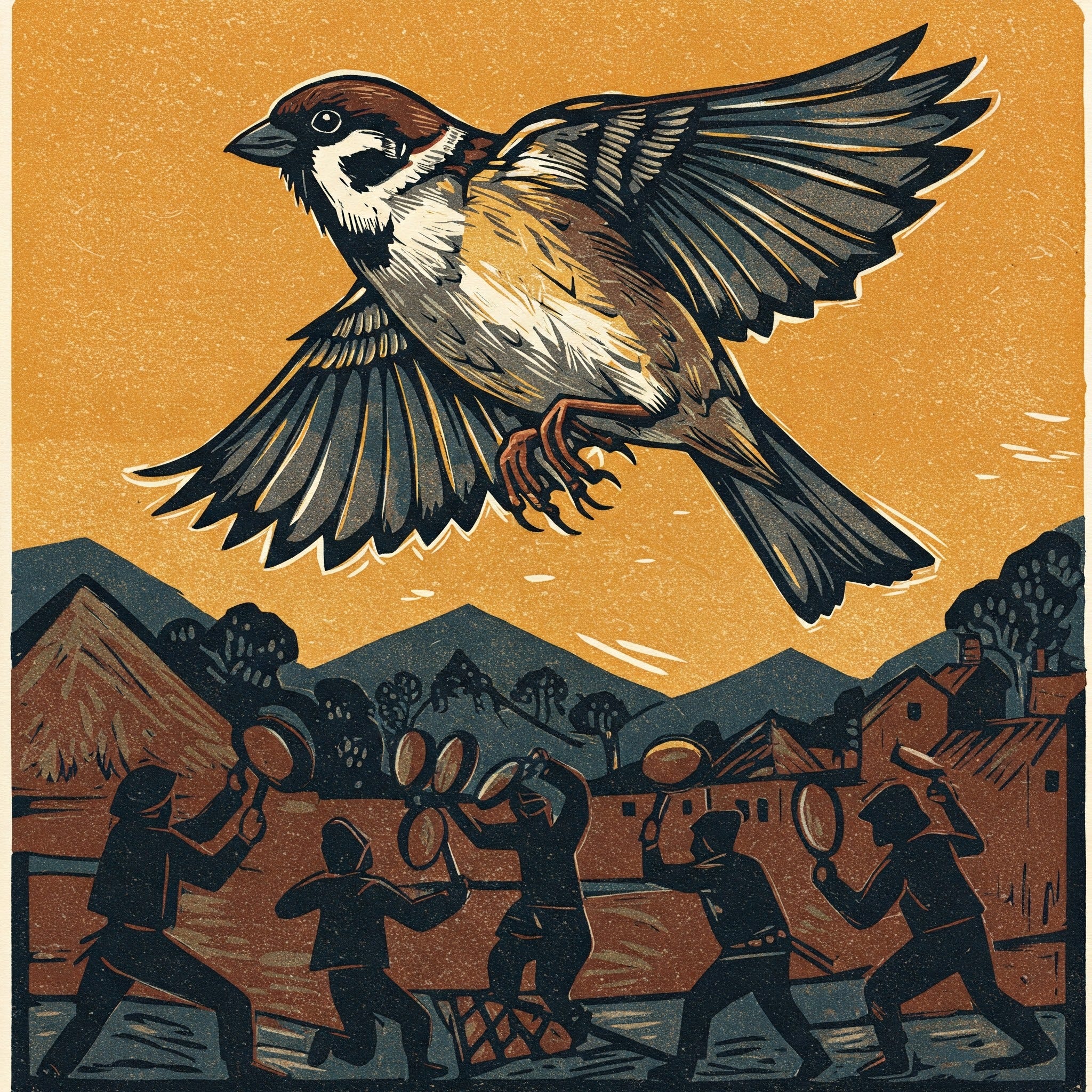
I don't know about you, but often I find myself looking for workshop stimulus (picture, song, poem, object) with such a strong idea of what I want that I can never quite track down an exact match. Hours can pass in fruitless web searches. I'm pretty sure this wasn't always the case. In the days before the internet the chances of finding exactly what, you thought, you were looking for were incredibly slim. As a result the mind was more open to stumbling across something new or interestingly tangential. There was a sensitivity to the possibility in found material that is hard to maintain when a dozen more google searches might find the very thing that is already in your head. Yet I've found some of my best workshops have come from these found stimuli - a snippet of lyrics in a café, a conversation with an opinionated taxi driver, or random article in a local paper left on a train.
In this spirit of random inspiration I will dedicate a post now and then to sharing some stimulus and challenge you to find the relevance to whatever you are working on. I won't suggest exercises, workshop plans or even target groups - that's up to you. I will, however, add some potentially generative questions as a starting point. It would be great to hear what this leads to in practice.
Death by Pots and Pans
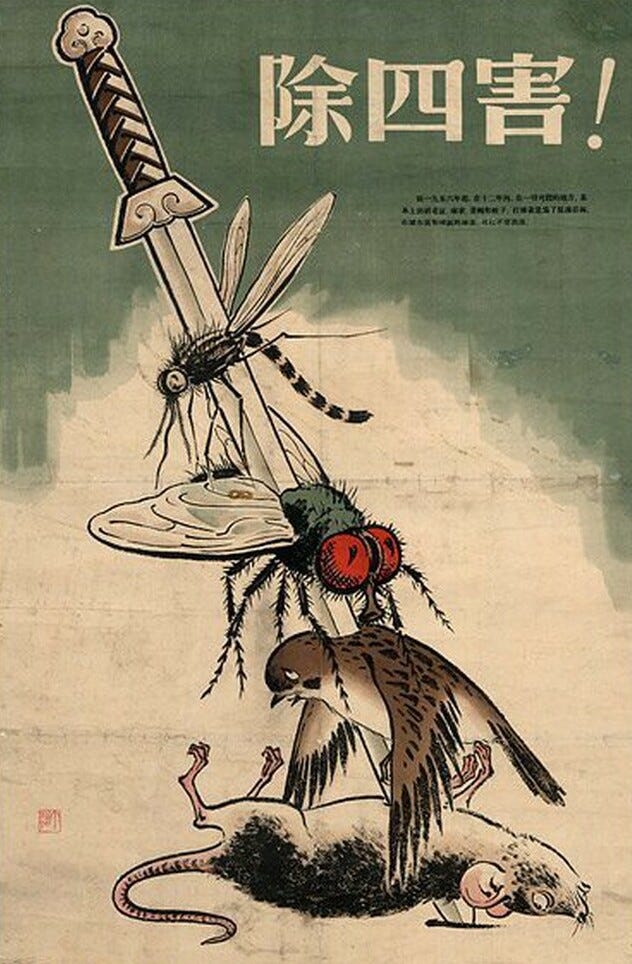
In 1958 the Chinese government, under Mao, sought to eliminate the sparrow (and three other pests: the fly, mosquito, and rat). It was hoped this would increase food productivity because sparrows eat grain.
Sparrows were trapped, shot, and their nests and eggs destroyed. Where nests could not be reached, enthusiastic citizens would bang drums and pots near nesting sites, causing sparrows to continue flying until they dropped dead from exhaustion. According to some sources, the Polish embassy garden in Beijing became a sanctuary for the sparrows until residents surrounded the walls of the garden and banged drums nonstop for days. The embassy staff used shovels to clear the dead birds.
With the absence of sparrows, a natural predator, the populations of crop-eating insects, particularly locusts, experienced an explosive surge. These locust swarms then proceeded to decimate agricultural fields, consuming vast quantities of grain and rice intended for human consumption. This massive intervention in the ecosystem contributed to a famine in which 20-75 million people died. Mao rescinded the kill order on sparrows in 1960, but it was too late.
China later had to import thousands of sparrows from the Soviet Union.
Broad Themes
Unintended Consequences:
Have you ever tried to fix something and accidentally made it worse? What happened?
Why wasn't the negative consequence foreseen?
Are unintended consequences common? In real life? In stories?
Human Impact on Nature:
If the outcome were different - a bumper harvest rather than famine - would the decision to kill the sparrows have been the right thing to do
The story focuses on the Sparrow. Do we have the same concerns about mosquitos, flies, and rats?
Do we have a duty to protect the environment, even if it means giving up some economic benefits?
The story above frames the humans as villains. How might the story be told from a human perspective?
The Power of Collective Action and Obedience:
Imagine a situation where a leader asks everyone to do something unusual. What might make people follow or not follow?
Imagine a situation where the person in charge makes a mistake, but no one is allowed to question them. What could be the result?
Why did the people pursuing the sparrows get so much enjoyment from it?
Would this count as a 'witch hunt'? If so, why?
Now we have more access to information are witch hunts less common?
Final note
Obviously the events outlined above are enmeshed in a latticework of complex historical factors. As a result, unless your participants are studying a relevant aspect of history my instinct would be to lean into the fable/parable nature of the story for fear of over simplifying the complexities of the Chinese Communist Great Leap Forward. Indeed, I did wonder about removing the historical references altogether, but then the poignancy of the tale lies in its truth - a dilemma best left to your judgement. Nevertheless, whilst the story is a potent example of the dangers of propaganda we must take care to not allow it to become propaganda itself.
To cite this article:
Burns, B (2025) Death by Pots and Pans. The Philosophical Theatre Facilitator: www.philosophicaltheatrefacilitator.substack.com
© Brendon Burns 2025
Sources
Alekna, J. (2024) Seeking News, Making China. 1st edn. Stanford University Press
Lou, S. (2005) Sparrows, Bedbugs, and Body Shadows. 1st edn. University of Hawaii Press
Steinfeld, J., (2018). China’s deadly science lesson: How an ill-conceived campaign against sparrows contributed to one of the worst famines in history. Index on Censorship, 47(3), pp.49–49. https://doi.org/10.1177/0306422018800259.
Zhou, X. (2013) Forgotten Voices of Mao’s Great Famine, 1958-1962. 1st edn. Yale University Press