
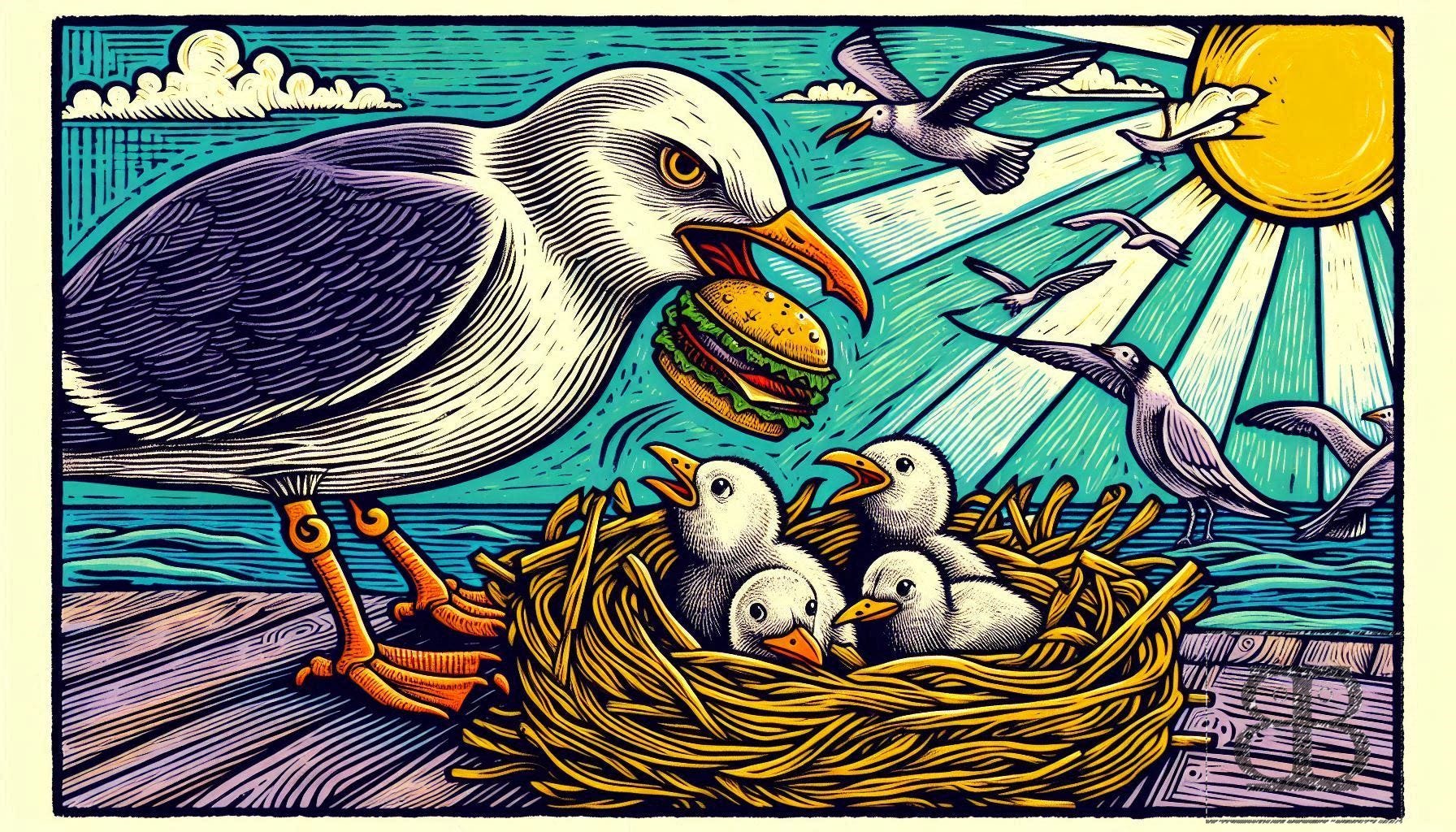
Ever resourceful, a seagull spots a car who has parked a bit too far away from the drive-thru hatch of some identikit burger franchise. As the server and customer reach towards each other our seagull swoops, gliding through, snatching the double xl special sauce of the month fish burger and flies away. Customer and server are left arms outstretched like Michelangelo's Creation of Adam.
"Poetry, pure poetry" thinks the seagull "the kids will love this.”
Back at the nest the hungry chicks squawk with delight, their heads, open mouthed, bobbing up and down as they see their parent approaching. Alighting on the edge of the nest the seagull drops the burger with a flourish. The chicks look from the seagull to the burger and back to the seagull. The bravest prods at the burger a couple of times with its beak then as one the chicks turn back to the seagull and recommence their hungry squawking.
SO YOU'VE JUST READ a great book about a theatre practitioner, or participated in an inspiring workshop, maybe you've come across a website or blog that talks about theatre in way you hadn't thought about before. 'I'll have that' you think and whack it into your next session only to see it fall completely flat. Instead of lighting the touchpaper of the group's interest you're left with the uninspiring dull pffft of a damp squib and the feeling of coming up short. Or maybe you've turned to an experienced friend or mentor for ideas when rehearsals are stuck in the doldrums. You do exactly as they suggest to little or no effect. Bad advice, you think. "Always works for me" they say. Sound familiar? I'd wager we've all fallen into the 'Fast Food Seagull' fallacy at some point.
Understanding the error
The fallacy here is a matter of mistaking correlation for causation. We assume the personal impact of the exercise/technique/idea lies exclusively in the material when in reality a whole range of factors contributed to your positive evaluation. If these other factors were missing and/or different when you repeated the exercise (or concept or detail or technique) then there would, of course be a different outcome. To put it another way, the physical replication of the exercise may be a necessary part of your insight but it is not, in itself sufficient to bring about the same impact. Perhaps it was the way the activity built upon some things you already knew or had experienced in the past. Maybe there was something about the way the exercise was delivered on that day, for that group of people, that you hadn't noticed. Or the activity moved towards a goal you had already committed yourself to. These unacknowledged factors fall into three main groups:
1. Prior knowledge or experience
Example: Fresh from a month long Commedia Summer School in Italy a director decides to share one of the games they learned with the youth theatre they led. It was a physical version of Rock ,Paper, Scissors but with Pantalone, Brighella and Arlechino. I was a participant in the Youth Theatre. We had done some basic Commedia before, so the game ran but the interactions were fairly flat and tokenistic. "It was hilarious when we did it Italy" rues the Youth Theatre Director. Strangely enough, I encountered the same exercise five years later in the middle of a 12 week commedia module at drama school- and yes, this time, it was hilarious.
2. The context of delivery
Example: There's an exercise I often use in Theatre for Democracy projects as a warm up for discussion. I ask the audience to stand (or raise a hand if I'm not 100% sure standing is ok for everyone). The exercise then proceeds with "Remain standing if you.... like toast. If this doesn't apply to you sit down". The exercise is repeated a couple of times with the questions moving from general (have ever told a lie, broken a promise) to more specific issues (decided not to use public transport because of the cost, had an idea that would benefit the neighbourhood). It's a gentle way to get everyone involved in expressing simple binary preferences or views on uncontroversial topics. Some weeks after using the exercise as part of a Theatre for Democracy workshop I had run in Austria I received an email from one of the participants. The message was courteous but brief pointing out that my 'Standing exercise did not work'. We corresponded, and it turns out the participant had misworded the questions and said " Stand up if....". This makes a huge difference - if you are in any way unconfident it is easier just to remain seated. Indeed the secret of the exercise, as I had explained in the workshop, is that participants are already standing - to agree or assent to the statement they don't have to do anything. Furthermore it turns out he used the exercise in a discussion about Sexual Health. "Stand up if you have ever..."!
3. Personal goals and preferences
Example: I was once documenting a workshop for a long established practitioner. They had recently developed an interest in NLP and found it personally transformative. In the workshop I saw they attempted to integrate a number of techniques into a session for teachers interested in classroom drama. The participants were bemused and actually called a halt to the workshop. They couldn’t see the point in what they were doing. The facilitator explained how the exercise helps adapt our ‘mental programs’. One of the participants responded that they were perfectly happy with their mental program but were looking for ideas on how to use drama in their literature class.
It’s perfectly possible for all three factors to impact delivery. Indeed one of the most common instances of the fast food seagull I’ve seen is when the facilitator attempts to recreate a session they experienced during their training at drama school. They forget the whole curriculum that had led up to that exercise (1), and would likely have been unaware of the factors that influenced the tutor's decision to do it on that particular day ,nor the safety nets that had been built into the process (2). Lastly but most importantly they fail to consider that a drama student's commitment to perfecting 'the craft' might not be shared by the members of the knit and natter group who have volunteered to be in a community play (3)!
You've no doubt now guessed where I was heading with the opening analogy. Seagulls generally feed their young by first eating the food and then regurgitating it in a form suitable for the needs of the chicks. As is so often the case, metaphors can only take us so far before we get tied up in details - and we'll all be happier for not delving into the mechanics of regurgitation. Suffice to say the gull in our story in failing to digest the material first, has assumed that what, for them, is a great meal would be equally nutritious for the chicks. Likewise a copy and paste exercise/concept/technique without prior 'digestion' assumes a level of universal application that is rare for anything but the most basic material.
The "Fast Food" bit of the title is not a value judgement on the quality of the meal (though the image obviously works better with a burger than a piece of broccoli). No, it’s recognising that part of the error is in rushing to use the new material. Fast food is so named because it eliminates the need to plan, source ingredients and cook. Do we want our workshops to be the equivalent to Kevin's Fried Chicken?
Potential consequences
Lack of connection- participants comply with instructions but find no relevance.
Misfire- The exercise grinds to halt or has unintended negative impact.
Deflation -The participants pick up on the facilitator's positive expectation and then feel they have ‘failed’
Running Repairs - The facilitator recognises the activity isn't going to work and has to make alterations on the fly.
Pseudo-achievement- Participants will not remember what happened in the session.
Ways of interrupting the fallacy:
If copying, borrowing, or throwing-in material from a third party, there are five simple questions that can help avoid the Fast Food Seagull fallacy.
What knowledge or experience is needed to fully engage with this exercise/concept/technique?
What are the mechanics of this exercise/concept/technique? What makes it work? What are its limitations?
What level of commitment, goal or purpose does this exercise/concept/technique require?
Given the answers to Q1-3 above what alteration would be needed for this material to work with the group?
Given the answer to Q4. would this exercise/concept/technique still be useful for the group.
Always an error?
Technically yes, but the negative impact of the fallacy can be small to negligible for simple exercises. Equally, an experienced group may be able to take it in their stride. Nevertheless, the fallacy is best avoided.
Bonus Fallacy: The Fine Art Seagull!
Same as before but this time the seagull raids an art dealer
and brings the chicks an 18ᵗʰ Oil painting of a herring.
The Gull can't understand when the chicks later complain of being hungry.
Error: When we throw in a concept, exercise or technique in name only and then expect the group to recall it as embodied knowledge. Often occurs as a result of the Train Drivers Dinner fallacy.
Example: Briefly describing "Marx's Alienation of Labour", "Emotional Recall" or "Rib-Reserve breathing" and then being surprised when the group claims no knowledge of the material in the next session.
Always an error?: Sometimes ok if mentioned as a stepping stone to other material that is then fully embodied.
Click here for more facilitation fallacies
To cite this article:
Burns, B (2024) The Fast Food Seagull. The Philosophical Theatre Facilitator: www.philosophicaltheatrefacilitator.substack.com
© Brendon Burns 2024