
The issue with issues!
The Issue Song:
Religion, acne, bullying, cancer
Issues, issues
Abortion, suicide, knife crime, dogma,
Issues, issues
Female genital mutilation
Issues, issues

There's so many issues in the world today
We need to see them in a play.
And he can write them, hip-hooray
Because he's the king of the issues.
I'm the King of the issues,
Issues, issues, issues

The League of Gentlemen Live Again,
Hammersmith Apollo, 2018
Issues, issues
Abortion, suicide, knife crime, dogma,
Issues, issues
Female genital mutilation
Issues, issues
There's so many issues in the world today
We need to see them in a play.
And he can write them, hip-hooray
Because he's the king of the issues.
I'm the King of the issues,
Issues, issues, issues
The League of Gentlemen Live Again,
Hammersmith Apollo, 2018
LET’S FACE IT, there is an issue with 'issue work' in drama and theatre! As hilarious as the the League of Gentlemen's TIE parody is, I dare anyone involved in educational theatre to watch 'Legz Akimbo' in action without experiencing a pained wince of recognition. This is perhaps unsurprising. Messrs Gatiss, Pemberton and Shearsmith have stated that they drew inspiration from theatre companies they worked with early in their career.
Of course, the appalling insensitivity, tokenism and blatant prejudice to be found in 'Everybody's Out', 'No Home 4 Johnny' and 'Scumbelina' is exaggerated for comedic effect. I am certainly not suggesting, for a moment, that these aspects are reflected in the work of established theatre education professionals1. Nothing could be further from the truth.
But, there are few practitioners who do not secretly flinch at the mention of 'issue based plays' or 'issue led workshops'. Visions of stereotypical devised work or the bludgeoning message of drugs/homelessness/bullying TIE performances are hard to escape. And yet, I'm guessing, we've also all experienced, and possibly created, powerful, thought-provoking work in this field. The difference, I would argue, is in how we unconsciously interpret the word 'issue.'
Issue or Problem?
In common usage, 'issue' has become synonymous with 'problem'. We might talk about psychological issues or IT issues as easily as we might refer to psychological or IT problems . But then we also have usage in other contexts - “this month's issue of Vogue” or “the issue of marital union” (children) - where 'problem' definitely doesn't work as a synonym. However, if we take a look at the etymology of the term 'issues', we can see a root that makes sense of all cases.
We derive the modern word issue from Middle English ischewe meaning 'out flowing', which in turn comes from Old French issir (to exit) and a root in Latin exire (to go out). So, stripped back to its essential meaning, an 'issue' can be seen as something that flows out of, or is produced by, something.
To contrast this, 'problem' comes from the Ancient Greek πρόβλημα (próblēma), meaning barrier, obstacle, or fence, itself rooted in προβάλλω (probállō) - to throw something in front of someone. So, while a 'problem' is static - an obstacle to be overcome, an 'issue' is dynamic - in motion. Hegel defines the cause of this motion thus:
“contradiction is the root of all movement and life; it is only in so far as something has a contradiction within it that it moves...”
Hegel (2010:382)
'Issues', then, could be seen as emerging from, or flowing out of, contradictions. Social/political/personal contradictions create social/political/personal issues. It can be helpful to conceptualise this visually:
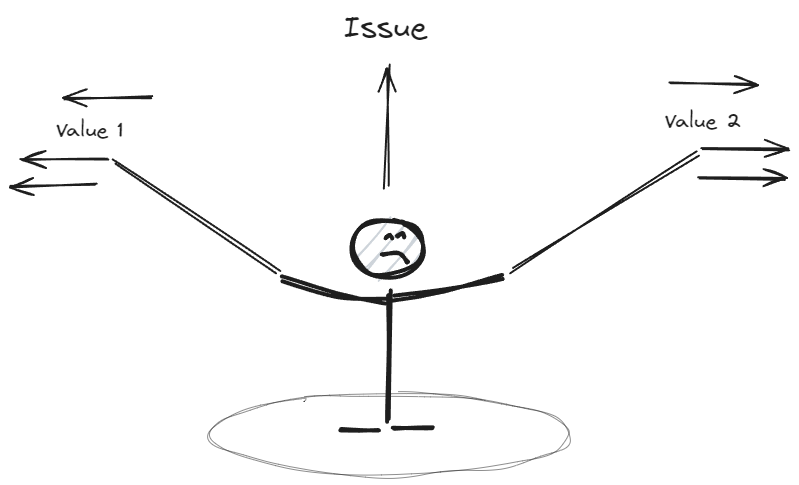
Our character (an individual or society) is being pulled in opposing directions in their attempt to adhere to contradictory values or desires. The 'tug of war' style tension creates movement in a third direction - and what emerges is 'the issue.'
So, to take recreational drug addiction as an example, the issue is produced by the contradiction between the desire to feel good/escape bad feelings and the desire for physical/mental wellbeing and avoidance of harm. Resolving the contradiction becomes more complex if the two values are closely weighted (even more so if we take into account other value pairings that sit in parallel with this issue). There is no clearly defined answer, only renegotiation of the relative weight of the values to find an acceptable compromise. There is no win-win scenario with an issue.
Finding a solution when framing addiction as a problem, however, is much easier. If 'drug addiction' is seen as an obstacle, then theatre work that hammers home moral messages suddenly make sense. There will be no problem if you 'just say no', or are sufficiently scared by the melodramatic demise of the protagonist to stay away from 'drugs'.
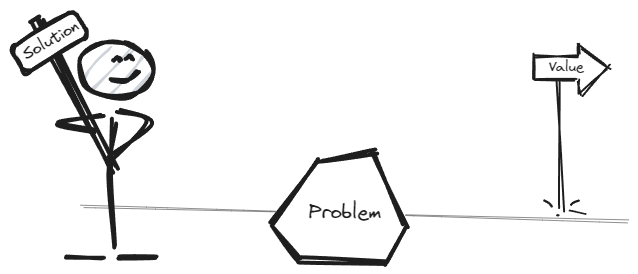
This then, I would argue, is the key difference between the cringe inducing 'issue plays' discussed in the introduction and the more impactful work we might have seen, or hope to produce. The former provides pre-prepared answers, the latter, creates space for questions and analysis. One is an attempt to impart dominant values, the other an invitation to weigh a range of values against each other. It may be an oversimplification, but the difference between training and education also comes to mind.
Practical Applications.
You might have noticed that the tug of war illustration of 'issue' above bears some resemblance to the final scene of Brecht's Caucasian Chalk Circle - this is no coincidence. The notion of human action being rooted in a nexus of contradictory forces is absolutely central to Brecht and Piscator's vision of Epic Theatre. I'm sure many of you have already recognised that what I've been articulating about issues vs problems is essentially the differences between dialectical vs didactic forms of theatre and theatre making. With this in mind, there are a plethora of existing schemes and exercises that can be used to ensure your 'issue' work sits in a dialectical rather than didactic/solution frame.
Using contradictory stimulus to begin writing or devising, for instance, will allow issues to emerge authentically. The challenge of resolving conflicting desires/values/imperatives can be a strong starting point for an improvisation. Equally, an existing issue can be reversed engineered to discover its component contradictions. This is particularly useful in scene or character analysis and can be very effective in avoiding polarising value judgements when a character does something we might not agree with.
There are two things I feel I need to make very clear as I wrap up this section. Firstly, I have focused on recreational drug addiction due to its ubiquity as an example of 'bad' TIE and, for clarity and brevity, the issue analysis of addiction is purposely simplistic. Real issues are multi-layered, the contradictions messy and difficult to measure or quantify. It takes considerable skill and care to negotiate the issue of issue work!
Secondly, and most importantly, this is not an exercise in semantics. I can think of many current uses of the word problem that fully encompass the characteristics of an issue (Freire's 'Problematisation/Problem Posing Education' and Conklin's 'Tame vs Wicked Problems' both come to mind). Language is constantly changing and evolving. What a word meant and what it means now are completely separate things. The etymology is useful only in so much as it helps us distinguish between concepts that have become conflated over time. This is not about being the 'word police'. You could argue that the words don't matter as long as the thinking is precise. I agree. It is, however, much harder to communicate precise thinking with imprecise vocabulary.
Bibliography
Aronson, J., 2006. The matter with “issue”. BMJ, 333(7577), pp.1059–1059. https://doi.org/10.1136/bmj.39013.652905.DE.
Conklin, E.J., 2006. Dialogue mapping: building shared understanding of wicked problems. Chichester, England ; Hoboken, NJ: Wiley.
Freire, P., Macedo, D.P. and Shor, I., 2018. Pedagogy of the oppressed. 50th anniversary edition ed. Translated by M.B. Ramos New York: Bloomsbury Academic.
Hegel, G.W.F. and Di Giovanni, G., 2010. The Science of Logic. Cambridge: Cambridge University Press.
Oxford English Dictionary, 2024a. issue, n. [online] Oxford University Press. Available at: <https://doi.org/10.1093/OED/6465552493>.
Oxford English Dictionary, 2024b. problem, n. [online] Oxford University Press. Available at: <https://doi.org/10.1093/OED/8217366941>.
Legz akimbo Theatre Company Links
Everybody Out: (1999)Series 1 Episode 4 (09.12-12.44, 21.07-24.31)
No Home 4 Johnny (2000)Series 2 Episode 6 (11.26-13.45, 21.48-23.50)
Vegetable Soup (2002) Series 3 Episode 3, (05.46-7.57, 18.17-20.40)
Perve Swerve (2017) Anniversary Special 2 (00.25-01.30, 10.09-11.35, 15.32-19.25)
Scumbelina (2001) League of Gentlemen Live at Drury Lane
Issue Song (2018) League of Gentlemen Live Again, Hammersmith Apollo
Hastily thrown together TIE programmes by actors with no educational experience out for a quick buck are, unfortunately, another matter altogether.