
Two Doors Into Creativity
A distinction worth making before the next "let's just play"
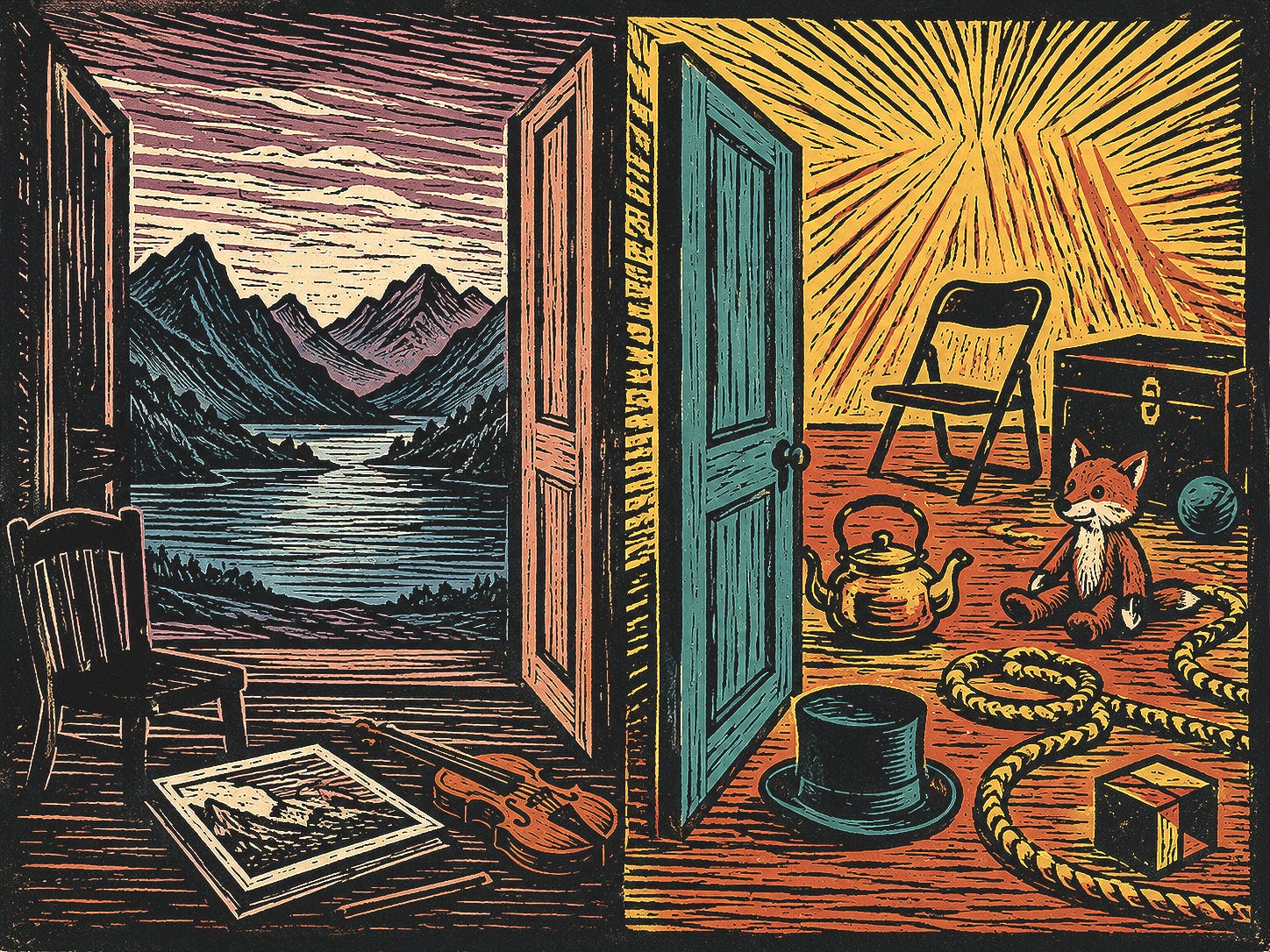
A Saturday youth theatre group, fifteen of them, sat in a wide circle. I’ve passed round a photograph – black and white, a station platform, a woman with a small suitcase, a child looking somewhere off-frame. Music is playing, mostly solo cello. During the preceding break I placed a small piece of tar and a saucer of beeswax on the radiator - the smell of both are permeating the room. As the group look at the photo I say: “She’s about to leave. Or she’s just arrived. Or she’s been waiting all day. We don’t know. Take a moment and imagine what happened during the hour before the photograph was taken.” For five minutes they don’t speak. Some have their eyes closed. One of them is mouthing words. Nobody is making anything yet. Everyone is making something.
A studio in north Hampshire, four adult performers I’ve worked with before, a pile of objects in the middle of the room – a battered top hat, a length of climbing rope, a folding chair, a brass teapot, a stuffed fox. “I’m going to tidy the chairs for the next quarter hour. Don’t make anything in particular but think about myths and adventures. Don’t show me anything. I’ll be over there.” I turn my back, and put the radio on. Within thirty seconds someone has put the teapot inside the hat. Within two minutes there are four small pieces forming, none of which will ever become a finished thing in itself, all of which somehow ends up in our retelling of Theseus and the Minotaur.
Both the rooms described are doing the same job – opening the space where creative work begins. From the outside you might call both “exploration.” But the rooms feel nothing like each other, and a facilitator who runs them as if they were interchangeable is going to cause problems.
Two doors, not one
The first room is what I’ve come to call a Landscape. Its door into creativity comes through the body and lands in the mind. The work starts with a stimulus to point the senses at: a photograph, a piece of music, a single object placed in the centre of the floor, even a memory. Distractions should be minimised. The room gives permission to be still. The facilitator’s job is to bring the stimulus in, frame it, and then mostly keep anything irrelevant out of the way of the imagining.
The second room is a Playroom. Here creativity flows unconsciously out through the body. The work starts in contact – picking a thing up, putting it on your head, throwing it to someone else, finding out what happens. It needs materials, loose or no goals, fluid time, and one thing above everything else: the sense of not being watched. The facilitator’s job here is the opposite: not to curate, but to scatter – to vacate the room without leaving it.
In the Landscape, the world acts on the mind: image, sound, object or atmosphere becomes inner material. In the Playroom, the mind acts on the world: impulse meets object, hand meets material, and something visible begins to happen.
The mistake most rooms make is to ask for one and arrange the other.
You can ask a group to “imagine something extraordinary” while sat in a brightly-lit ring of chairs with every face pointing at every other face, and wonder why their imaginings come out so safe. You’ve built a Parliament and asked it to be a Landscape. The bodies in the room know what kind of room it is, even if the words you say are about somewhere else.
Equally: you can drop a basket of props in the middle of an enthusiastic group, say “have fun with these, see what comes up,” and then stand directly in front of them with a flip-cam. Nothing will come up. You’ve built a Gallery and asked it to be a Playroom. The flip-cam alone will hold the door shut.
Underpinnings
There’s a deeper claim underneath this. “Be creative” is not an instruction the body can act on. The nervous system doesn’t act on instructions; it acts on predictions – small, fast, continuous guesses about what the room expects of it. The room is doing more of the talking than the facilitator is. Always. What we call “permission” is mostly environmental, not verbal.
What we call ‘permission’ is mostly environmental not verbal.
A Landscape and a Playroom are not two flavours of the same activity. They trigger two distinct sets of predictions in the body. One asks the body to go still and let stuff in. One asks the body to move and find out. Both serve creativity. Neither will substitute for the other.
Landscape and Playroom sit within a larger pattern I use to plan workshops – eight rooms, or zones, in total, paired by what they serve. The other three pairs handle the rooms where ideas combine, where work gets refined, and where groups prioritise what to do next. Each room has its own cue, its own requisites, its own quality of facilitator presence.
I’ll be teaching all Eight Zones – and rehearsing how to build each room when you’ve only got one dusty hall to work with at The Lowry on Saturday 18 July 2026. If the distinction above feels like one you’ve been bumping into, that’s the day to come and work it through in the room.