
When Santa brings you the wrong project!
Common fallacies in Theatre Facilitation.
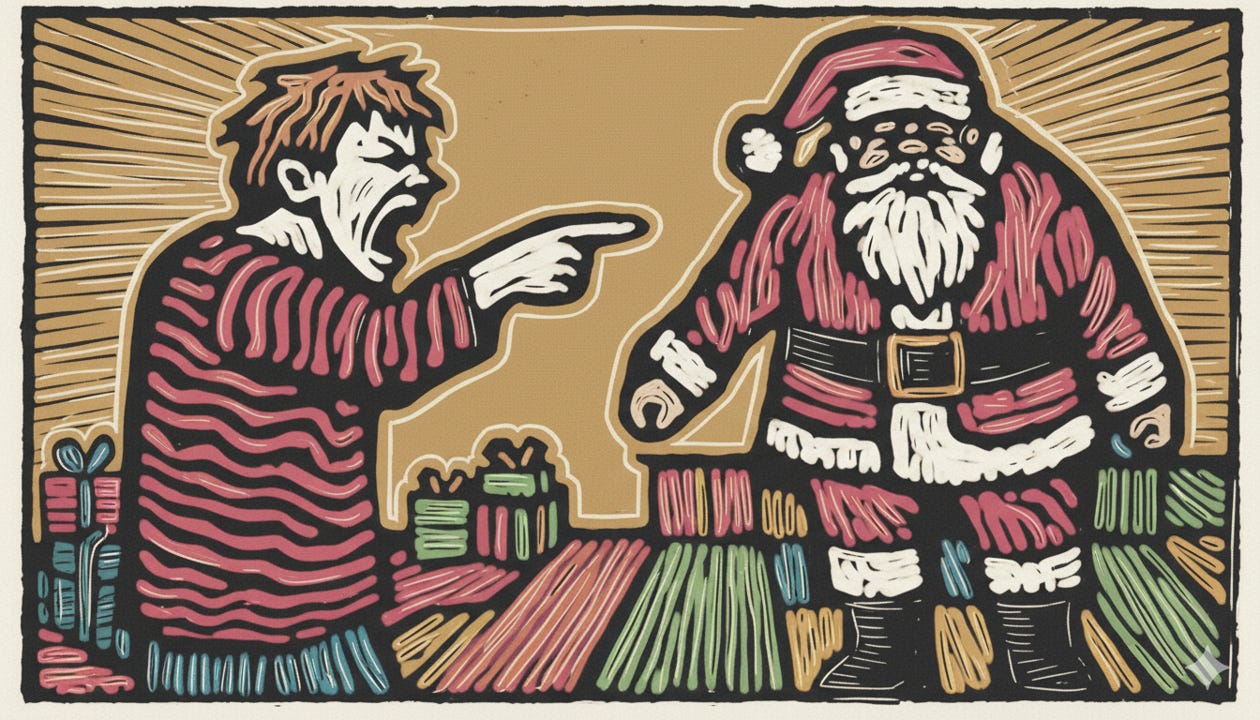
But I’ve been a good facilitator all year!
I IMAGINE we have all been there at some point. You planned the session in great detail and arrive to find you have to change everything. Or it's an amazing script, but this cast just won't engage with it. One of the participants has an issue which means you can't use your 'go to' exercise which everyone loves. In short, it is not fair. You do not deserve this. Santa brought you the wrong project.
Anyone who has studied logic or critical thinking will be familiar with the concept of a fallacy: an error in reasoning that renders a judgement or conclusion invalid. When we feel resentful that a session didn't go as planned, we may be committing the Just World Fallacy. "The world is fair", so the fallacy goes, "therefore bad things happen to bad people, good things happen to good people" which leads to the conclusion: "I worked really hard, and therefore I should get the outcome that I desired." Outlined like this, the error in reasoning is absurdly obvious and yet, candidly, I'm pretty sure we've all felt that type of resentment at some point -it’s only human. The problem comes, perhaps, when such thinking becomes a habit.
In psychology, an individual's ongoing predisposition to fallacious or skewed reasoning falls under the umbrella of 'Cognitive Biases'. The most common is 'Confirmation Bias', our tendency to prioritise evidence that supports what we want to believe over that which contradicts us. Equally common is the 'Foreseeable Hindsight Bias' - the belief that a past event could have been predicted (even when there were numerous possible outcomes).
Consider then, the long term impact on a practitioner for whom the Just World fallacy has become an ongoing cognitive bias. For a start, the facilitator will entrench a dynamic of vertical relationships, placing themselves in the position of beneficiary - the one who should be served. The participants/organisers (perhaps even the whole world) are now responsible for satisfying the facilitator's expectation of a 'deserved' outcome. Furthermore, even if the practitioner becomes self-critical and eschews the notion of denied deservedness (caused by the 'bad' participants/people/world) they fall prey to a fixed 'poor me' mindset - "Things always go wrong because that's what I deserve."
In both cases the participants miss out - the session marred by the shadow of what would/could/should've been. By failing to accept prevailing circumstances as value neutral, the facilitator also denies themselves the opportunity to grow and learn.
The process of moving through an unexpected occurrence is best seen in four stages - Acknowledge something has changed, Accept that it has happened, Adapt current plans in light of the new information and Act on the revised plan. Acceptance is necessary for meaningful Adaptation. A begrudging jump from Acknowledgement to Adaptation can too easily get bogged down in feelings of resentment.
Is this a recipe for unthinkingly taking whatever the world throws at you? Of course not, it is more a case of being realistic about what is currently in, or not in, your control. Post session reflection may lead to an active decision to avoid certain types of work, develop more flexible plans etc. And conceivably there could be occasions when the only appropriate adaptation actually means saying "I'm sorry I can't deliver anything under these circumstances." - but in my experience this is incredibly rare.
Some facilitators can take a good project and make it mediocre Others can take a mediocre project and make it good. In the end, success is measured by what you do with what you've got - that is the job. To paraphrase the philosopher Marcus Aurelius - the obstacle is the opportunity, what gets in the way becomes the way.
Facilitator's Fallacies
Over the years, I've identified a number of fallacies that commonly affect theatre facilitation. Many have an equivalent in informal logic or cognitive psychology, but I like to rename them to focus on the aspects a facilitator might more easily recognise. Below are a few examples. I will dig deeper into these (and others) in future posts.
Survivor's Joy or "It was alright on the night!"
When we finish a session we had been dreading and interpret the feeling of relief as a sign that we delivered a great workshop.
The Train Driver's Dinner
A train driver doesn't want to be late for dinner so they ignore all signals and fail to stop at stations (leaving passengers waiting on platforms) but get to the destination on time.
When we ignore the participants and just deliver the plan. We get faster and louder in a hurry to get to the final exercise and finish on time.
Just the two of us
When one or two participants enthusiastically engage with an idea or activity, and we latch onto this and deliver the rest of the session solely to them, more or less ignoring the others.
The Monkey Trap
A monkey puts its hand into a jar to steal a ball of rice. The neck of the jar is too narrow for the monkey to remove their hand whilst holding the rice. Unwilling to give up on the rice the monkey is trapped.
Those times when we hold on so tightly to an idea or outcome that we fail to see it is the very thing that is stalling the process.
Bad Decision or Fallacious Thinking?
The thing about facilitation fallacies is that they appear to make logical sense to the facilitator in that particular moment. In some cases the fallacious proposition comes from a third party. Other times, and perhaps more commonly, the fallacy sits firmly within the mindset of the practitioner and might more accurately come under the heading of a cognitive bias.
Sometimes, on reflection, the fallacy itself is obvious but more often it is the decisions that result from fallacious thinking that stand out. We recognise the ‘bad’ decision, but not the fallacy. The problem with this is that any feedback or reflection focuses on the decision itself as the mistake rather than the thinking that justified it. As a result, whilst the facilitator may resolve never to make that mistake/decision again, the fallacious inferences will be repeated in different contexts. This then adds to the cognitive load of the practitioner as they try to remember an ever-increasing catalogue of things not to do again.
Recognising our fallacies and cognitive biases means we can intercept them. If you know you have a tendency to a Santa/Just World type resentment you might find a phrase to say to yourself when you feel it coming on: "Acknowledge and Accept, Adapt and Act", "What is the facilitator not accepting here?", or my personal favourite "What have you got for me this time Santa!". Simply bringing an awareness to the pattern of thinking is normally enough to get you back on track.