
Workshop or Workstore
Why the word 'workshop' carries a promise worth keeping
We were sitting behind the set eating our lunch, keeping out of the way, when we heard the familiar dfff of a radio mic turning on. Eyes were rolled, mine included. Then there was a second dfff. By the fourth dfff and the tell-tale sound of stands being moved we all nodded. Turns out you really Can’t Stop the Beat.
Around thirty years ago, the UK government introduced a specialist college programme. Secondary schools could apply for designation – and the funding that came with it – as centres of excellence in particular subjects: technology, languages, arts, sport. In principle a good idea. In practice, a complex one.
Performing arts facilities had historically been underfunded, and many departments had been working in spaces that were never designed for theatre in the first place. The new investment solved some long-standing problems.
I was director of a company touring into schools during much of this period. This meant spending long days in their performance spaces: fit up, performance and workshop, strike. In between, you catch things. A class coming in to rehearse during lunch. Drama club setting up after the last bell. Fragments of other people’s working days glimpsed from the corner of the room.
The before/after transformation in the specialist arts colleges we visited was impressive: new performance spaces, upgraded lighting rigs, professional-grade PA systems, tiered seating – the kind of staging that would have been remarkable ten years earlier. In several cases we were even met at the door by a dedicated performing arts technician.1
Something started to bother me. What I began to notice, in these newly equipped spaces, was a particular kind of work: note-for-note, move-for-move reproductions of the dominant West End and Broadway musicals of the moment, performed with considerable technical polish. The singing was often excellent. The choreography had clearly been worked on. The investment had plainly found a purpose.
For a while I wasn’t sure what to do with the observation and the disquiet I felt. It wasn’t musical theatre versus drama prejudice.2 Or scripted versus devised work. Neither was it a puritanical aversion to the use of technology – I’m an enthusiastic early adopter. More importantly, the new kit had opened a range of non-performance roles that had previously been impossible.
The disquiet was somehow to do with creativity, or more precisely, its absence. Not a creativity deficit that could simply be cured by switching to devised work, but an absence of ownership: the sense that the decisions shaping the work actually belonged to the people making it. Without that, performing – particularly for a non-professional – can easily become a consumer activity: passive reproduction of someone else’s experience.
A shop is where you make things
The distinction between making something new and reproducing something existing turns out to be encoded in a pair of words that British English has done its best to blur into synonyms.
Shop comes from the Old English scoppa – a stall, a booth, a small structure attached to a larger one. Related to scypen, meaning a cowshed. The Germanic cousins include Schuppen (still used in German for a garden shed) and the Old High German scopf, meaning a porch or outbuilding. The family resemblance is consistent: a shop is a place where something happens. Where things are made, worked, practised, assembled.
Store has a different lineage and a different logic. From the Old French estorer, meaning to furnish or supply, from the Latin instaurare – to set up, to establish stock. A store is a place where things already made are kept and distributed. The distinction is between production and provision. Between the smithy and the warehouse.
In American English the difference is still audible: you go to the hardware store to buy what someone else manufactured; you go to the workshop to make something yourself. In British English the two have blurred – but the underlying meanings haven’t gone anywhere.
And there it is. Workshop. A compound of work and shop – work, from the Proto-Indo-European werg-, simply meaning “to do,” and shop, meaning the place where the doing happens. The word has carried this meaning since the sixteenth century. A workshop is, etymologically, a place where something is made.
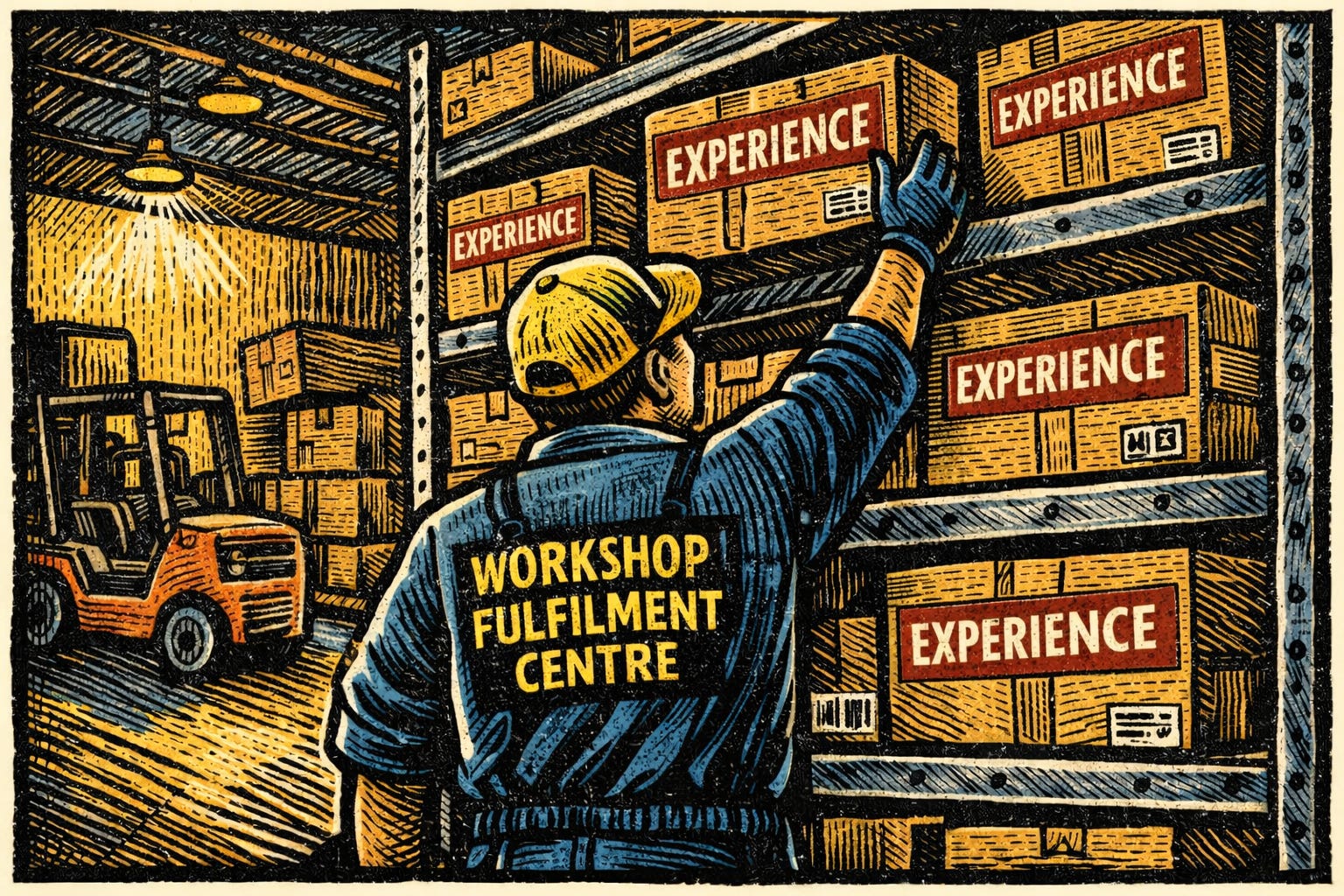
Are we running workshops or workstores?
The specialist arts schools had invested heavily in their capacity to store and distribute existing work. Better staging makes it easier to reproduce a professional production. Better audio equipment closes the gap between the West End cast recording and the school hall.3 These are genuine improvements to a school’s ability to provide access to what already exists in the repertoire.
What they had invested in rather less was the capacity to make something that hadn’t existed before the students walked into the room – whatever form that making might take.
More precisely: the capacity for participants to experience themselves as the makers. Not consumers of someone else’s decisions but the people whose presence in the room actually shaped the work.
The conditions that shape creative agency can’t be found at a theatre tech expo. Time matters: longer sessions, smaller groups, and enough staff to work with them. Some specialist schools achieved parts of this. Many did not.
I don’t raise this to be uncharitable about what those schools achieved. And I’m aware the pressures on arts departments – to justify the funding, to demonstrate outcomes, keep numbers up, and produce something impressive on the night – are real and considerable. Choosing a big musical is a rational response to those pressures.
The specialist schools programme that produced those well-equipped theatres no longer exists.4 The pressures have not disappeared, though – they have simply taken different forms. One current version appears in examined drama work. Students are often required to demonstrate the influence of recognised practitioners: Frantic Assembly, Katie Mitchell, Berkoff and others. The intention is entirely sensible. Exam boards need ways of recognising and assessing creative work, and named traditions offer a shared vocabulary for doing that. But occasionally the sequence runs in reverse.
I recently overheard a drama teacher asking colleagues which practitioner might reasonably be said to influence a piece their students had already devised. The work existed; the label had yet to be chosen.
There is no criticism implied here. The teacher had no choice but to respond as the system required. But the moment is revealing. The practitioner becomes less a source of methods than a category the work can be placed inside – a way of identifying what has been emulated so it can be assessed. The pressures look different, but the underlying dynamic is recognisable.
The promise in the word
It’s worth being precise about what these examples are doing here. The students running a musical number are rehearsing. The exam class working through a practitioner module are in a lesson. Neither context is the target. Both are examples of something that can happen anywhere: the making space collapsing into a distributing space. I use them because the dynamic is visible – a school production makes it easy to see the difference between a room where something is being made and a room where something is being delivered.
But the distinction I’m drawing is not between lessons, rehearsals and workshops as formats. Workshops contain learning. They often involve rehearsal. A lesson can open into genuine making; a rehearsal can produce something no one planned. The question is not what the timetable calls the session, or even who chose the material. It’s whether the people in the room are contributing to and changed by what emerges – or simply processing what was decided before they arrived.
The word workshop carries a promise. It says: something will be made here. Not retrieved from a catalogue, not reproduced from a recording, not stored on a shelf until the appropriate occasion. Made – from the materials in the room, by the people in the room, for whatever purposes bring them here.
That promise is harder to keep than it sounds. And worth keeping track of – because the pressures that turned those school productions into workstores don’t only apply to secondary arts departments.
They apply to anyone who calls what they do a workshop.
P.S. If you’d like to explore these ideas in practice rather than just on the page, I’ll be running workshops in Liverpool this April.
Details, tickets, and full outline:
https://www.brendonburns.org/liverpool-workshops-april-2026/
To cite this article: Burns, B. (2026) Workshop or Workstore. The Philosophical Theatre Facilitator: www.philosophicaltheatrefacilitator.substack.com
© Brendon Burns 2026
Sources:
Harper, D., 2001–2025. Online Etymology Dictionary. Available at: https://www.etymonline.com Onions, C.T. ed., 1996. The Oxford Dictionary of English Etymology. Repr. Oxford: Oxford University Press.
An invaluable role when the new equipment arrived.
It's true MT isn't my area of expertise, but I've directed a few and, when a performer, I paid my dues as Benny in Guys and Dolls and was a mean ol' Lion in The Wiz. Even now I'd be tempted back by an invitation to play Herod in JC Superstar!
It's also important to remember the equipment and spaces could also foster collaboration across music, drama, dance and other departments. Though again, such collaborations require time.
Shelved as part of austerity cuts in 2011. Five schools have retained the title though they no longer receive the specialist grant.