
You Are Out!
Elimination, stranding, and changing my mind about ‘victim games’
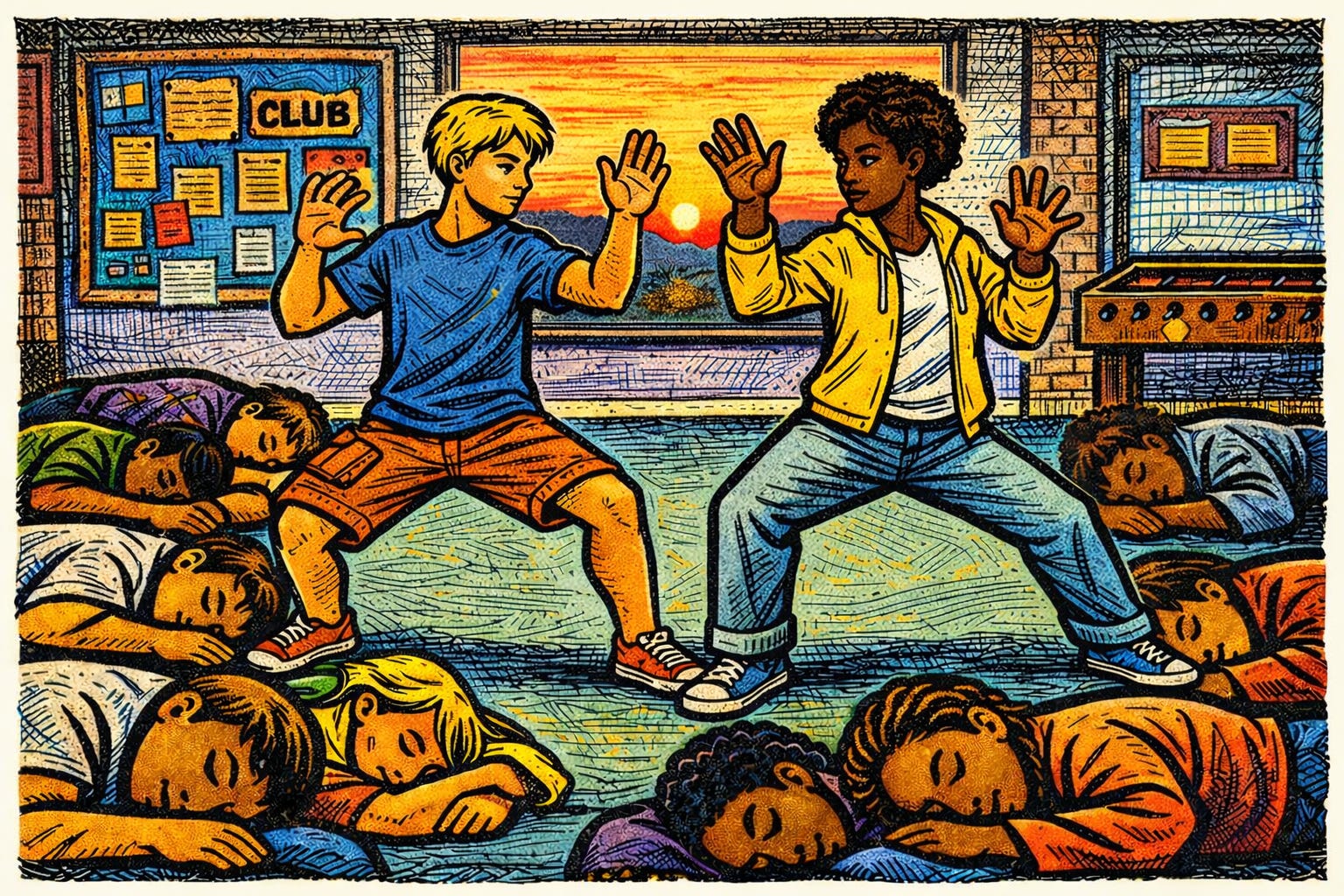
THE PARTCIPANTS ARRIVED UNFOCUSED AND CHATTY. There was a core group who clearly knew each other well and a few who seemed less confident. Perhaps this was their first time. I sat in a corner trying to be as unobtrusive as possible. The facilitator was a student on placement, I was observing - a week into a new job - unfamiliar with either the group or the student. They began with a game of Ninja.
Participants take turns striking stylised martial arts poses and making attacks across the circle. There are rules - quite a few of them - and if you are hit, you are out and the circle becomes small. An odd choice as an opener I thought, but then again, it wasn’t a game I had really come across before. The group clearly had, and loved it. Within seconds, the room snapped into focus. Bodies sharpened, attention locked in, laughter and competitive energy surged. I remember thinking, very clearly, perhaps this is a good warm-up choice after all.
Forty minutes later, the last two players began the final round.
Elimination
The first person had been out in under a minute. By any reckoning, that participant spent roughly two thirds of the workshop sitting at the side of the room, watching. The same was true, to varying degrees, for a growing number of others. The game had worked exactly as designed. It had also quietly undone the stated purpose of the session. The actual workshop was squeezed into the last twenty minutes.
This moment has stayed with me because it captures the central problem I have with elimination games in workshop contexts. Not competition - competition is often useful. Elimination is something else.
Splat, Wink Murder, Night in the Museum, Ninja - these games are popular for good reasons. They are clear, playful, and generate instant focus. The sense of being tested - by others, by timing, by the rules themselves - can be energising and concentrating. Roger Caillois calls this agon, the pleasure of structured contest.1 It’s not the problem.
Elimination introduces a second mechanism that is often treated as incidental rather than structural. It removes people from the field of play altogether.
In very short games this may not matter. But as group size increases, or as games run longer, elimination scales badly. The facilitator cedes control of timing to the game’s internal logic - it ends when it ends, not when the room needs it to end. The better the game “works”, the more participants it excludes. If the purpose of a warm-up is to prepare the group physically, mentally, and attentively for the main work, then a structure that steadily cools the bodies and minds of the majority works directly against that aim.
Facilitators know this. Adaptations are common. Those who are out become judges, callers of mistakes, timekeepers. These gestures are often framed as inclusion.
But they are compensations, not participation.
Watching is not the same as doing. Calling is not the same as risking. Unless an exercise has been designed so that observation is the learning, those sitting out are no longer warming their bodies or sharing the uncertainty that gives the game its charge.
According to James Carse:
There are at least two kinds of games.
One could be called finite, the other infinite.
A finite game is played for the purpose of winning, an infinite game for the purpose of continuing the play
Elimination games are, by definition, finite. Their success condition is that most players stop playing. Workshops are not. Their purpose is to sustain engagement long enough for something else to happen - learning, discovery, trust, skill, insight. A workshop that systematically removes participants is a finite game pretending to be an infinite one.2
This does not mean elimination games should never be used. Some eliminate so quickly that being out lasts only seconds. Others allow mistakes to accrue without removal from play. In some exercises, exclusion from action is deliberate because the learning resides in watching. The problem arises when elimination is treated as neutral simply because the game is familiar.
Stranded
Elimination removes people from play entirely. But there’s another way games can fail participants: by leaving them stranded within play. Clive Barker identified what he called victim games - exercises designed to place an individual under sustained pressure as part of theatre training. Games like Piggy in the Middle, or Breakout, where exposure is the point.
Other games - Duck, Duck, Goose, for example - are not victim games in themselves. But they can all too easily become victim games if conditions allow. A participant who is slower, less confident, or subtly targeted can end up stranded as “it” far longer than intended. The design is neutral. The social dynamics are not.
In my own practice I adopted a simple rule: avoid these exercises where alternatives exist, and where they are used, build in escape hatches so no one is left stranded. Generalising this as advice to facilitators in training I instinctively turned to Barker’s categories - “Victim games have their uses, but are best avoided until you have more experience - be particularly mindful of games structures that can inadvertently become such”
For a long time, this felt like sound advice. It probably was. When you’re learning facilitation, bright lines are useful. Don’t leave people exposed. Don’t let games drift into cruelty. Watch the room.
But as I kept working, the neatness of that distinction began to trouble me. The fear of creating a ‘victim’ - and the weight carried by that word - was narrowing what participants encountered. They rarely experienced being ‘it’ in a held context. Public missteps, when they occurred, were quickly smoothed over. Discomfort was treated as a problem to be solved rather than a threshold to be crossed with support.
This matters because workshops are not the world. If the first time someone experiences being singled out, losing publicly, or struggling visibly is when the stakes are real - when there’s no facilitator present, no warm frame, no one actively holding the room - then we haven’t prepared them. We’ve withheld something.
At this point, it became clear that the term “victim game” was doing two different kinds of work. Barker used it to identify games like Breakout - exercises structurally designed to place someone in sustained exposure. But I had extended it to include any game with victim potential - games that could accidentally drift into stranding someone through bad luck or group dynamics. One is a design feature. The other is a facilitation hazard.
That distinction matters. Because what I began to realise was that my blanket avoidance wasn’t just preventing the drift. It was also ruling out the deliberate, carefully held use of uneven focus altogether.
Victim games are volatile. Left unchecked, they can absolutely become corrosive. But that volatility is precisely why they require judgement rather than prohibition.
The problem is not illumination. The problem is abandonment.
When handled with care, tight spots can offer something important: a chance to be ‘it’ without becoming an it. A chance to be the focus without being defined by it. A moment of slowness or loss that is comic rather than cruel, temporary rather than terminal, and held by a facilitator who is attentive but not prematurely rescuing.
Seen this way, the key distinction is not between good and bad games, or safe and unsafe ones, but between structures that eject people from participation and those that deepen it. Elimination that removes players from the room is usually poor design. Exposure that keeps everyone in relation, even unevenly for a moment, can be transformational.
My position now is narrower and more demanding than it once was. Elimination games should be used sparingly, redesigned where possible, and timed ruthlessly. Victim games, in the Barker sense of the term, have a place (though I refer to them as ‘tight spots’ to avoid unnecessary baggage). They certainly should never be casual. But sustained, uneven focus should not be taboo. Carefully framed, clearly bounded, and understood as structural rather than personal, it can teach something difficult to learn elsewhere: how to remain in the game when held in the spotlight.
For facilitators, this shifts the question. Not “Is this exercise safe?” but “What kind of light does this cast, for how long, and to what end?” Who is held. Who is seen. Who is allowed to recover without being rescued.
In the end, this is less about games than about judgement. About recognising when a structure builds capacity, and when it quietly erodes it. About remembering that participation is not the absence of exposure, but the ability to stay in relation when exposure arrives. Not all intensity excludes. But some structures do.
Related work
In April, I’m running a small weekend of practitioner workshops in Liverpool that work directly with questions of judgement in live facilitation - particularly how structures shape participation over time, and how intensity can be held without exclusion.
Details here:
https://www.brendonburns.org/liverpool-workshops-april-2026/
To cite this article:
Burns, B (2026) You Are Out!. The Philosophical Theatre Facilitator: www.philosophicaltheatrefacilitator.substack.com
© Brendon Burns 2026
Sources:
Barker, C., 1978. Theatre games: a new approach to drama training. London: Methuen.
Caillois, R. and Barash, M., 1958. Man, play, and games. Urbana: University of Illinois Press.
Carse, J.P., 1986. Finite and infinite games: a vision of life as play and possibility. first Free Press paperback edition edn. New York London Toronto Sydney New Delhi: Free Press.
In Man, Play and Games (1958), Roger Caillois distinguishes four types of play: agon (competition), alea (chance), mimesis (simulation), and ilinx (disorientation or vertigo). The sharpened focus generated by Ninja belongs firmly to agon — the disciplined pleasure of struggle within agreed constraints.
James Carse, Finite and Infinite Games (1986). Although Carse writes philosophically about human interaction rather than workshop practice, his distinction between finite and infinite games is useful here. Finite structures may operate within infinite purposes, provided they do not overtake them.