
Your Character Isn’t Stupid – So What Are They Doing?
Why intelligent people make self-defeating choices – on stage and off
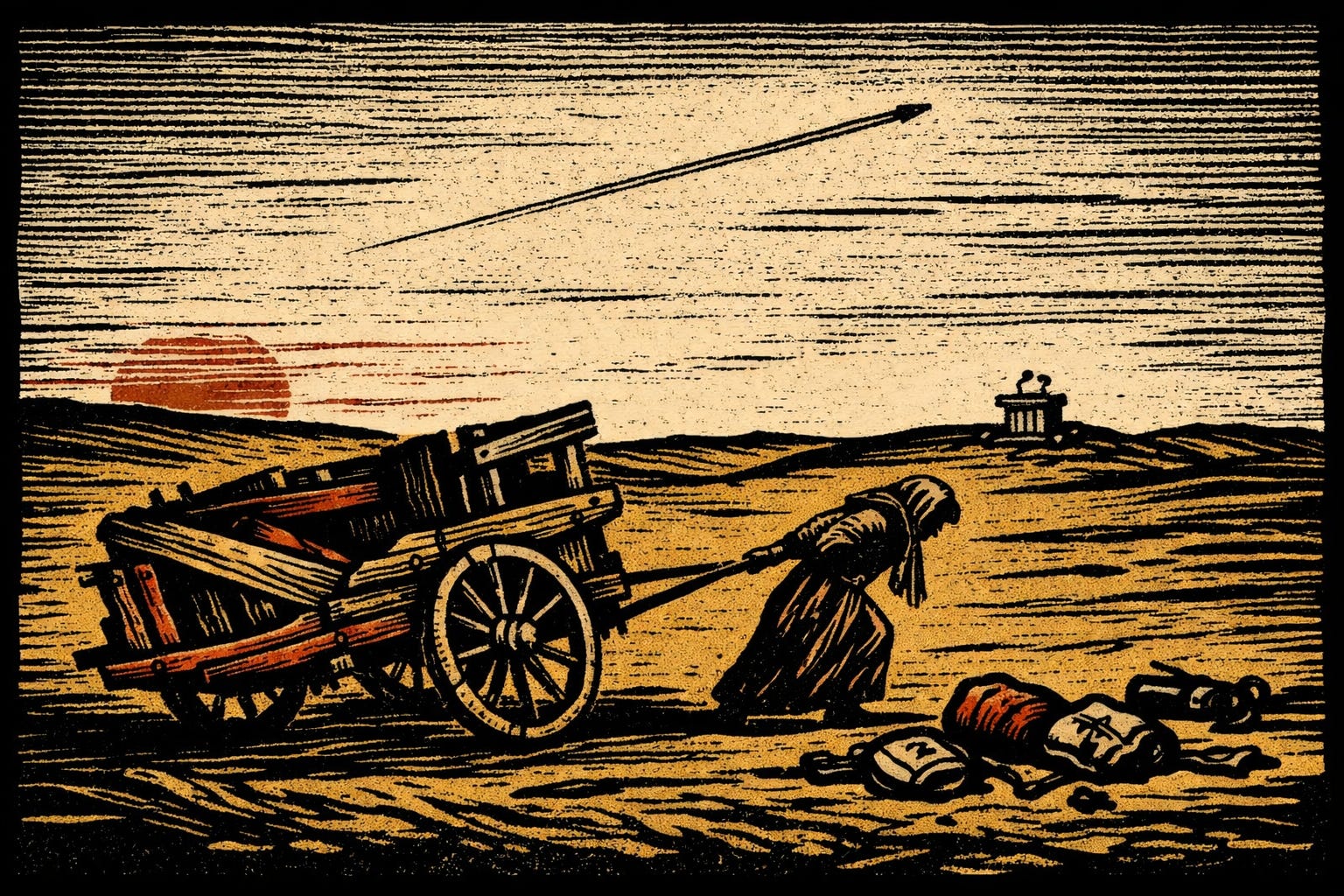
You swallow your anger. You stifle the itch. You eat tomorrow.
THERE’S A MOMENT in Brecht’s Mother Courage where everything the play is about crystallises into a single scene. A Young Soldier storms in, furious, ready to demand justice from his captain. Mother Courage talks him out of it. Not through argument - through a song. The Grand Song of Capitulation. She sings about how she too once believed in standing up for what’s right, in refusing to march in step. And then she learned better.
The soldier leaves, defeated. Courage, having talked him out of his complaint, realises she’s also talked herself out of her own. Eight scenes later she’s lost both sons and her daughter. But she’ll eat tomorrow.
It’s almost always played for bitter irony. But if we only see Courage as stupid - if the audience response is “well obviously you shouldn’t capitulate” - then the scene has nothing to teach us. We’re just watching someone be thick.
And that’s a problem that goes well beyond Brecht. Every rehearsal room, every workshop, every facilitated conversation eventually hits a moment where someone holds a position that seems obviously self-defeating. A character who throws away their second chance. A participant who defends something that’s clearly hurting them. A leader who knows the moral case and chooses pragmatism anyway. The temptation is always the same: they’re just stupid. And once you’ve decided that, you’ve stopped thinking. Which is a problem, because they haven’t stopped doing.
Whose drama?
I had a student at drama school once - enthusiastic, committed, loved drama. We were deep into a production, well past the point where everyone else had shifted into thinking about the audience’s experience. During notes, while the rest of us were working out how to make the play better, he asked if his parents would be able to see him in the curtain call.
Now, if a thirteen-year-old in a drama club asked that, you’d think nothing of it. But this was vocational training. He’d chosen this as a career. The rest of the company was working in service of the play, and he was still in a place where drama was his - the thing that made him special, the thing his family came to see.
I didn’t feel sympathetic. It was a type of vanity. But recognising the dissonance meant I could name it: this shift you’re struggling with is real. It’s going to feel like a kind of mourning. The professional values that replace what you’re letting go of will more than compensate - but right now it feels like loss.1 That’s not sympathy. It’s diagnosis. And diagnosis gives you something to work with.
Frozen Chickens Don’t Care
If “stupid” is a dead end, you need another way of reading what’s going on. One that assumes the thinking is coherent, even when the outcome isn’t. There’s a framework from moral psychology - Jonathan Haidt’s Moral Foundations Theory - that I’ve found genuinely useful in the rehearsal room. Haidt’s research suggests we make moral judgements drawing on six foundations:
Care / Harm - sensitivity to suffering, the impulse to protect
Fairness / Cheating - justice, reciprocity, playing by the rules
Loyalty / Betrayal - commitment to the group, solidarity, ‘us’
Authority / Subversion - respect for hierarchy, tradition, legitimate order
Sanctity / Degradation - purity, disgust, the sacred
Liberty / Oppression - resistance to domination, autonomy
We all draw on most of these. But we weight them very differently, and the weightings often only become visible when they collide - or when someone transgresses a value that matters to us but can’t easily be justified in terms of harm.
Haidt’s most provocative examples work precisely because no one is hurt. A family eats their dog after it’s killed by a car. Someone uses a national flag to clean a toilet. A person has sex with a frozen chicken and then cooks and eats it. Most people react with immediate disgust, then struggle to explain why it’s wrong - because the wrongness isn’t located in harm. It’s located in Sanctity, or Loyalty, or some foundation that doesn’t need a victim to be activated.
This is what makes values collisions so difficult to navigate - in a rehearsal room, in a workshop, in a staffroom, anywhere. The person isn’t being irrational. They’re processing the situation through moral architecture that weighs differently to yours. And until you can see the architecture, all you’ve got is: they’re just stupid.
“She’s Just Stupid”
A few years ago I was directing a TIE production and we hit the same wall from the other side. The character was Corey, a young woman who’d been offered a genuine fresh start. New family, new crowd, a way out. And what does she do? Goes straight back to shoplifting.
The cast couldn’t get past it. “She’s just stupid,” someone said, and rehearsals stalled. Nobody could find a justification that didn’t boil down to pathology or innate badness. And you can’t play pathology. The audience checks out because that’s not them.
I didn’t have an answer either. What I did have was a roll of wallpaper and some markers. I rolled it out on the floor and asked the cast to write down the most absurd, ridiculous reasons Corey might start stealing again. The sillier the better. The mood shifted. People were laughing, bouncing off each other.
Then we went through them looking for seeds of logic.
The actor playing Corey had written: “Corey is stealing to save up for cosmetic surgery.” Why? “Her friends are good-looking, and she isn’t.” Five minutes later the whole thing had cracked open. The shoplifting involved skin care, hair products, perfume, make-up. Previously, theft had been a way of bonding with a boyfriend from the wrong side of town. Now it was the means by which she could fit in with the crowd from the right side of town. Corey wasn’t a loner. She was consumed by the need for belonging.
In Haidt’s terms, the cast (and her family) had been reading Corey through Care and Fairness - someone gives you a chance, you take it. Corey wasn’t choosing irrationally. She was prioritising Loyalty – belonging – over long-term self-interest. Same intelligence. Different architecture. Still heading for trouble. But now we had something to play.2
This Time Next Year...
So what’s Courage actually doing? She values her family - that sounds straightforward until you notice the form it takes. Her Care is real, but it’s inextricably tangled with short-term material survival: feed the children today, keep the wagon moving, do the deal in front of you. And her Loyalty isn’t to a community or a cause - it’s to her own way of doing things. She is the provider. Her way of surviving is the only way she recognises.
The Grand Song of Capitulation is the moment this becomes explicit. Courage’s position is essentially: survival requires you to strangle your Liberty and your sense of Fairness. Don’t stand up. Don’t demand justice. Stifle the itch. The Young Soldier keeps his life; she keeps her permit. In the short term, it works. Strategic cowardice as fireproofing.
I directed a professional tour of Mother Courage in 2008. The phrase that the cast and I kept coming back to was “this time next year.”3 It really opened up the play for us. Courage is always trading away the present for a future that never arrives. Don’t tear up the officer’s shirts for bandages - we might need them. Don’t refuse the deal - something better is coming. She has the courage to march into a war zone but lacks the courage to simply decide: we will not be involved.
Because Courage believes she is a partner to the war - that if she respects its Authority and follows its rules of trade, it will respect her back. Brecht shows us that the war is not a partner. It’s a predator. By stifling Liberty she loses the ability to change her situation. She becomes a passenger. And to keep the wagon rolling - to keep her version of Care operational - she repeatedly sacrifices the very people that Care was supposed to protect. She isn’t just marching in step to survive. She is marching her children to their graves.
The Noise That Matters
This is where Kattrin comes in. Courage’s mute daughter is the direct counter-argument to the Grand Capitulation. Where Courage spends the play stifling her moral impulses to eat tomorrow, Kattrin does the opposite. She climbs onto a roof and beats a drum to warn a sleeping city of an attack, knowing it will kill her.
During rehearsals we ran an exercise where Kattrin could speak - the idea was simply to make her internal dialogue explicit. What jumped out was something we hadn’t expected. Courage couldn’t hear her. Not ignoring her - couldn’t hear her. She had suppressed those values so completely that the voice articulating them had become inaudible. Kattrin’s silence isn’t only a psychological response to trauma. It’s a resonant metaphor for what happens to Care when it has no seat at the table.
And when Kattrin does finally find her voice - not through words but by banging a drum on a rooftop - it’s no coincidence that Courage isn’t present in the scene. The one moment in the play where Care acts decisively, Courage is somewhere else entirely.
Courage survives but loses everything. Kattrin dies but saves thousands. Brecht doesn’t sentimentalise Kattrin. That’s not the point. Kattrin is the one character whose values and actions are aligned. Her Care is not tangled up with trade-offs and short-term calculations. It costs her everything, and she pays it.
By the final scene, Courage’s strategy has won in the most hollow way possible. She has successfully avoided the stupidity of standing up for justice. She has successfully navigated the Authority of both sides. And she is alone, her children are dead, and she is still pulling the wagon, singing the same song.
Still Pulling The Wagon
None of this is a plea for relativism. Understanding someone’s moral architecture doesn’t oblige you to agree with them - it means you know what you’re actually disagreeing about. That’s a different skill from empathy and a more useful one. It’s what lets a director crack open a character the cast has written off. It’s what lets a facilitator work with a group that’s stuck on “they’re just idiots.” It’s what lets a citizen watch a press conference and ask not “why are they so stupid?” but “what are they protecting, and what is it costing them?”
Because I keep seeing the Grand Capitulation performed - not on stage but in press conferences and summits and carefully worded statements of concern. Leaders who understand the moral case, can see what’s happening, and still stifle the itch. Their Care is real - but it’s tangled with economic survival and a respect for an old Authority that no longer respects them back. This time next year, they tell themselves. The relationship will pay off. The trade deal will hold. The shirts will be needed.
Brecht’s question was never “why is Courage stupid?” It was “what happens when intelligent people are so afraid of tomorrow that they betray their values today?” It’s a good question for a rehearsal room. It might be an essential one right now.
P.S. If you’d like to explore these ideas in practice rather than just on the page, I’ll be running workshops in Liverpool this April.
Details, tickets, and full outline:
https://www.brendonburns.org/liverpool-workshops-april-2026/
To cite this article: Burns, B. (2026) Your Character Isn’t Stupid – So What Are They Doing? The Philosophical Theatre Facilitator: www.philosophicaltheatrefacilitator.substack.com
© Brendon Burns 2026
Sources:
Brecht, B., 1939. Mother Courage and Her Children.
Haidt, J., 2012. The Righteous Mind: Why Good People Are Divided by Politics and Religion. London: Allen Lane.
Prior to professional training, drama is usually a leisure or educational pursuit. Relatives say, “Our Jo loves their drama,” and ask, “Is Mo still doing his drama then?” The shift from ‘my’ drama to ‘our’ drama does not come easily; it involves a reorientation of values. The curtain call moment led me to address this explicitly with students at the start of the course.
Moral Foundations Theory opens up any number of dramatic conflicts where characters talk past each other. Antigone’s Loyalty and Sanctity against Creon’s Authority and Fairness. John Proctor’s Liberty against Danforth’s Authority. Once you start looking through this lens it’s hard to stop.
“This time next year Rodney, we’ll be millionaires” - Del Boy’s perpetual refrain in Only Fools and Horses. It took fifteen years, six series, and a desire to end the show on a high before it actually happened.
Playwrights, too, can fail their secondary characters like this.