
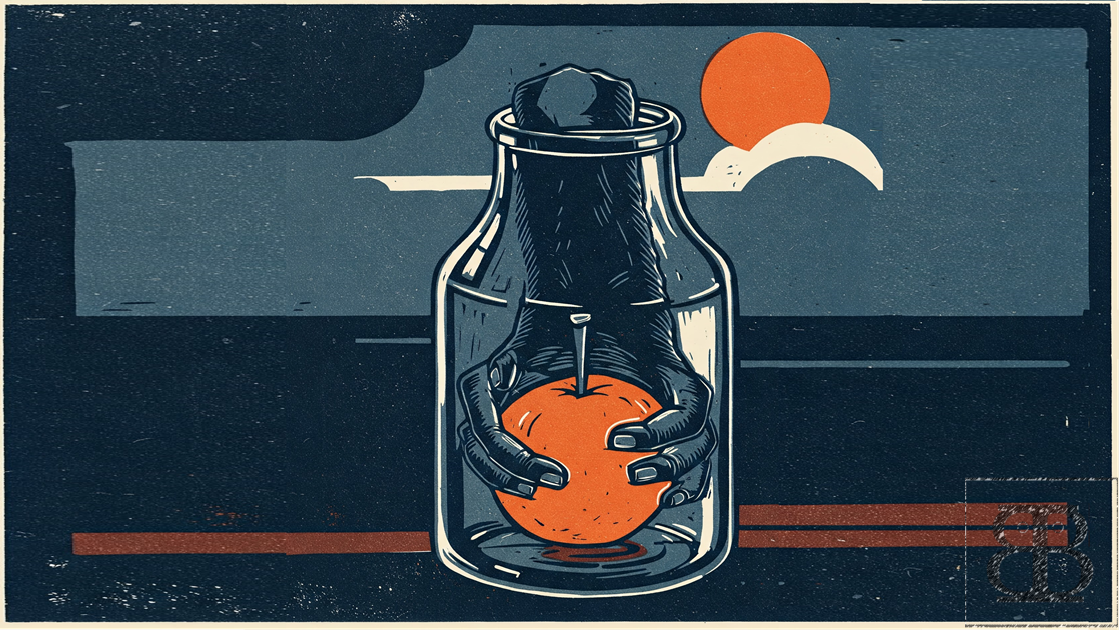
The folk tale begins with a hungry macaque monkey looking for breakfast. The monkey comes across a jar and notices a tasty piece of fruit inside. Bingo! The search for breakfast is over. Squeezing its hand into the jar the monkey grabs the fruit. Unfortunately, whilst the neck of the jar is wide enough for a hand to get in, it is too narrow for a hand holding a piece of fruit to get out. Our hungry friend, straining and twisting, uses all its might trying to extract the food, but to no avail. Still holding the fruit, the monkey attempts to lift the jar in order to smash it against a tree or stone… only to find it is chained to the ground. The rest of the troop appear. They crowd round, curious about the jar. The monkey holds on tightly to the fruit and hisses aggressively. A howl of alarm is heard in the distance and the troop departs in haste. The monkey tightens its grip even more as the hunter approaches…
IT WAS GOING SO WELL AND THEN IT WASN’T. Have you ever reached an utter impasse in a rehearsal or workshop process that had started so promisingly? You end up trying every trick/strategy/technique/ploy you know and still somehow you can’t gain traction again. Maybe you’ve observed this supervising a devising process. One group gets off to a flying start and you turn your attention to others who are struggling for ideas. You check back in later and find they have completely stalled.
Nature of error:
The monkey trap is a ubiquitous tale, probably South Asian in origin, made popular in modern Western thought by Robert M. Pirsig in Zen and the Art of Motorcycle Maintenance.1 The narrator in the novel uses the story to explore a concept he calls Value Rigidity:
The monkey reaches in and is suddenly trapped – by nothing more than his own value rigidity. He can’t revalue the fruit. He cannot see that freedom without fruit is more valuable than capture with it.
Value rigidity, according to Pirsig, is an inability to evaluate/re-evaluate information because of a commitment to a previous idea or decision. It’s allowing a perception to get stuck in a pattern. Like the monkey refusing to let go of the fruit even when the hunter is coming, value rigidity means clinging so tightly to an idea or way of thinking that you can’t adapt, change, or embrace new, potentially better possibilities. You become trapped by your own unwillingness to let go of the previous value, even if letting go would mean freedom or growth.
Stuck on: the first idea
It may be that the devising group above became stuck when the initial idea somehow ran out of steam - a not uncommon occurrence in any creative work. However, the level of excitement created by the ‘great’ idea might have resulted in an inability to recognise when the idea has reached its limits. Rigidity sets in. The fact that the idea is no longer working is staring them in the face, but they don’t recognise it. Likewise, new ways forward are invisible because all value (importance) is inviolably ascribed to the previous commitment.
Anchoring Effect: The ‘idea’ might be the first one that came to mind, the most vivid, or the one that has been focused on from the outset. This initial thought (the anchor) can disproportionately influence decision-making, making it difficult to consider alternative, potentially better options.
Stuck on: what we already know/care about
Let’s consider a different example. A workshop leader has been invited to work with a group of participants subject to social marginalization. The facilitator has read widely about this form of marginalisation and has deep personal commitment to addressing it. Based on a hunch, the facilitator becomes convinced that the participants are concerned about a specific, potentially controversial, societal issue. They begin the workshop. It is somewhat hard going - the group is reluctant to engage with the topic. Instead of revisiting the hunch in light of this new information the facilitator soldiers on. The group’s concern for the issue has clearly been deeply repressed - so the facilitator believes.2 The only way forward is through. That this may not be the right time or space never enters their mind. The group may need time to feel comfortable. The importance of the issue may not be felt equally amongst the participants. Or, indeed, felt at all.
Availability Heuristic: An issue might be judged as more likely or important simply because examples of it are easily recalled from memory, perhaps because they are recent, vivid, or frequently encountered. This readily available information can disproportionately influence judgments and decisions, leading individuals to overestimate its frequency or significance compared to less salient, but potentially more accurate, data.
Stuck on: what is mine
In our final example, let’s consider a theatre director who has a specific vision for a crucial scene. The description of this in production meetings led to gasps of awe. Artistic genius! Significant kudos for the director. However, during rehearsals, it becomes evident that the idea isn’t landing with the actors or is technically challenging for the crew to execute smoothly. The director stubbornly clings to the concept, bemoaning the unwillingness of the cast and crew to make it work. Precious time is lost that might have been spent developing an alternative.
Endowment Effect: We tend to ascribe more value to things we already possess or have created ourselves. The director’s big idea feels inherently more valuable simply because it originated with them. This feeling of ownership, often linked to psychological attachment or loss aversion, can disproportionately influence decision-making, making it difficult to objectively evaluate value or part with it when others might consider it reasonable.
Potential Consequences:
· Reduced engagement and participation.
· Compromised quality and effectiveness.
· Missed opportunities
· Damaged relationships
Ways of interrupting the fallacy:
In each of the examples the importance ascribed to each ‘idea’ is removed from the broader context that gives it value. The monkey values the piece of fruit as a means of avoiding starvation. However, avoiding starvation is part of the broader goal of staying alive. It would be better in this case to be a hungry live monkey rather than a dead one with food in its hand. The broader purpose of the action has been subsumed into a single measurable goal.3 We have promoted a possible means of achieving the goal to the only means of doing so. In a way the ‘idea’ has become a substitute for the whole.
It would be easy to reach for the oft-quoted axiom that creatives must be prepared to “kill your darlings”. This is not necessarily bad advice. All creativity requires a kind of ruthlessness as generation turns to editing and refinement. The phrase neatly captures the pain that accompanies the decision to excise cherished ideas. But we’re dodging the issue. The monkey probably never consciously decided to put its hand in and grab the fruit, much less refuse to let go of it. It was more likely a pattern of behaviour that had served it well in the past. Likewise, our own patterns may not be obvious to us on a day-to-day basis. ‘Kill your darlings’ only works when you know what needs to be let go of and why.
Pirsig offers the following advice:
Well, the monkey should somehow try to slow down deliberately and go over ground that he has been over before and see if things he thought were important really were
It’s probably helpful here to point out that Pirsig is using the Monkey as a metaphor for a motorcycle mechanic trying to diagnose a fault.4 Like a mechanic, a facilitator or director is rarely, if ever, in possession of all the relevant information. Any decision or hypothesis must be open to question and change. All the more so when dealing with people rather than machines.
The suggestion then is to stop, stand back and try to re-engage with the fundamental goal, aim, driving force etc. of the activity in question. Only then can you begin to untangle the unconscious commitments that got you into the pickle in the first place. Personally, and I’ve lost count of how many times my hand has been stuck in the jar, I find it useful to draw or physically map out the project. A long walk, bath, or swim can also be extremely useful. This is not dodging or procrastinating. In fact, I’d go so far as to say it’s a professional responsibility. This type of quiet and conscious reassessment is far more effective (and sustainable) than the more rash impulses to kill darlings or, in a more self-help paradigm, go full Elsa and just ‘let it go’.
Questions for Reflection:
What is the ultimate goal here?
If the idea was impossible to realise what would you do instead?
Can the idea be seen as a stepping stone rather than the end point?
What evidence would it take to convince you that the idea is not working or is no longer the best approach?
Whose needs does this idea ultimately serve?
Always an Error?
I’m always slightly concerned that my Facilitator Fallacy posts might be taken as somewhat of a telling off. You do X and X is wrong because of Y, deduct 5 facilitator points and here’s (another) stick to beat yourself with! In reality the fallacies only achieve this status because of their proximity to perfectly appropriate ways of working. This is particularly true here.
I’ve no doubt that my examples above will have provoked as many ’ yeh-but-what-abouts’ as they did knowing nods. Who hasn’t met with the group that jettisons everything they’ve worked on at the first obstacle? Who hasn’t let their own reticence or lack of confidence prevent themselves from sticking with a group as they work through a tricky issue? And aren’t there times when you need to stick to your guns and prioritise a certain scene or piece of staging, even when others don’t agree?
Yes, though these counter examples are really just the same trap with different fruit.
Consider the devising group so invested in getting top marks that they change their idea for something ‘better’ each week. Think of the times when your fear of imposing actively prevents a group from engaging in issues of importance. Or when adherence to the rehearsal schedule, or an inclination to avoid conflict, leads you to abandon a vision for a simpler compromise. Same rigidity - different values.
So ultimately it’s less about whether we are in a monkey trap and more about figuring out which one you are currently stuck in!
To cite this article:
Burns, B (2025) The Monkey Trap. The Philosophical Theatre Facilitator: www.philosophicaltheatrefacilitator.substack.com
© Brendon Burns 2025
Sources:
Kahneman, D., 2012. Thinking, fast and slow. Penguin psychology. London: Penguin Books.
Pirsig, R.M., 2014. Zen and the art of motorcycle maintenance. New York: Vintage
Rosen, M (2018, February 8) Michael Rosen: The data have landed. Available from http://michaelrosenblog.blogspot.com/2018/02/the-data-have-landed.html
Pirsig encountered the story while studying in South India (though some references cite Pirsig mention South America)
Which may, of course, actually be true. The point I’m making is that this is never questioned.
The temptation to deliver the evaluation criteria rather than project’s aims is an insidious parallel to this. Consider Michael Rosen’s - Then the children only learnt what could be turned into data.
…and Zen and the Art of Motorcycle Maintenance is, of course, itself a metaphorical discourse on the art of living.