
The Poltergeist in your Workshop
Are you keeping faith with what matters?
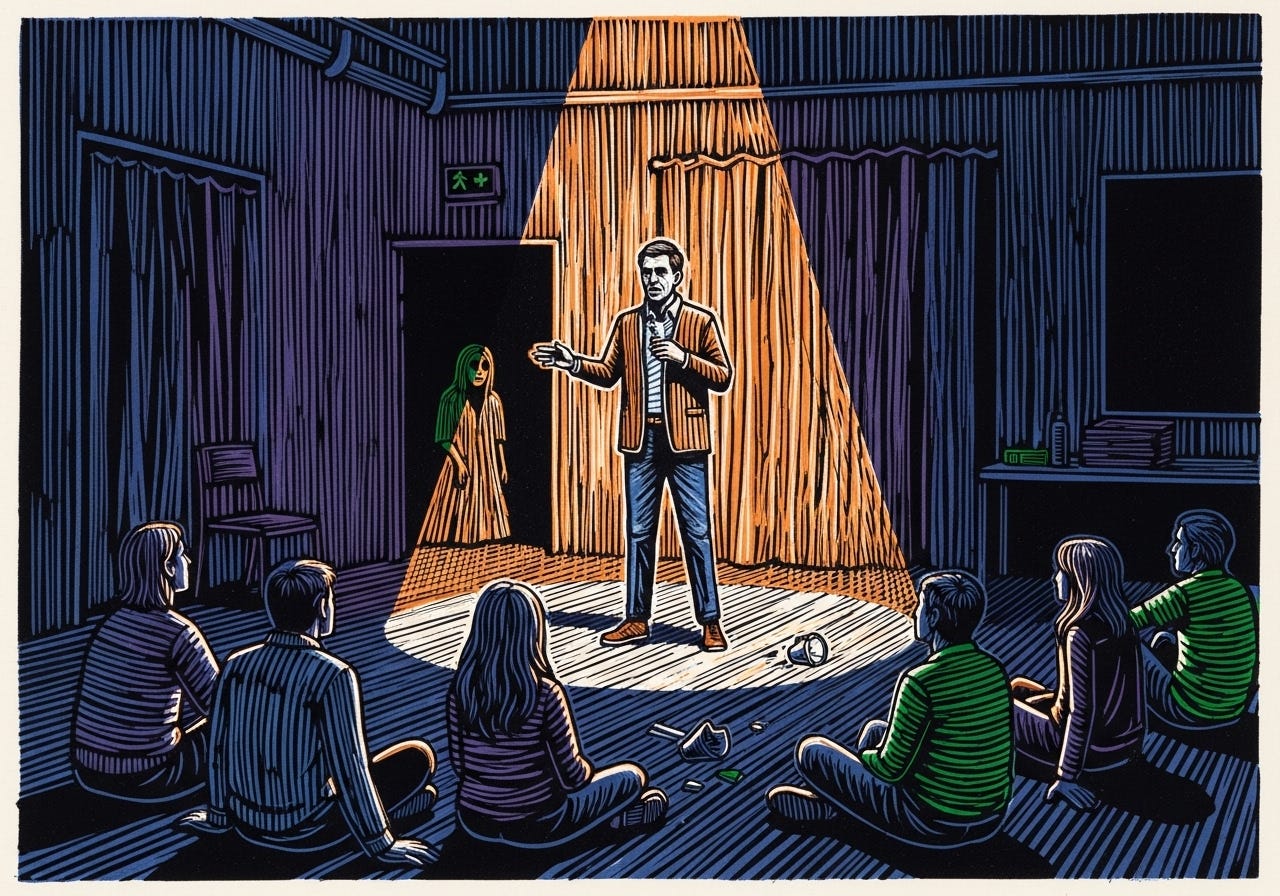
There it was again, that distinct impression of being watched. Not by the participants - they seemed equally uneasy - but by something older, something that remembered.
HALLOWEEN HAS JUST PASSED, and for those reading in the UK, Bonfire Night will be flickering into life as this piece is published. The proximity of these two celebrations is no coincidence. The Celtic forerunner to Halloween, Samhain, seems to have run for a few days before and after October 31st. As Christianity spread, the Church introduced All Saints’ Day on 1st November, appropriating and shortening this more ancient celebration. It’s likely, however, that rural populations stuck with the old dates. So when the King instructed the realm to celebrate the foiling of the Gunpowder Plot – a failed attempt to blow up Parliament – on 5th November 1606, bonfires and effigy burning were already on the menu.
Amongst other things, Samhain (pronounced Sow-win), was a time to honour ancestors. Various rituals are recorded involving inviting or guiding the dead back home and providing them with their favourite food. Failure to do so would anger or insult the ancestors and lead to acts of revenge – the ‘trick’ of ‘Trick or Treat!’
But honouring the dead wasn’t only about appeasement. It also held up a mirror to the living. Remembering ancestors meant thinking about the kind of people they were - their courage, generosity, sense of duty - and whether those qualities still mattered. In that way, ancestor rites acted a bit like moral housekeeping: a ritualised reminder that the living were custodians of inherited virtues, accountable not just to one another, but to the long chain of lives from which they came.
Who you gonna call?
Jump forward to the present day. You’re running a session but something doesn’t quite feel right. The Bluetooth speaker cuts out mid-exercise. A normally gregarious group stare at you blankly, and you find yourself repeating yourself. A cold chill grips you, even though the participants are flushed and sweating. Everything feels slightly off-kilter and you can’t shake the feeling of being watched.
There might be a poltergeist in your workshop.
Not a literal ghost, obviously.1 Our profession has its own form of ancestor veneration. We carry forward principles, techniques, and values – some inherited from mentors, some from influential practitioners we’ve never met, some from theoretical frameworks that shaped our thinking. These aren’t the actual people - who were, after all, flawed humans like the rest of us - they’re the symbolic weight of what they represented: ways of working that mattered, values worth preserving, approaches that felt true.
When we drift from these foundational ideas – not consciously evolve past them, but unconsciously abandon them – something goes wrong. The workshop starts behaving as though it’s haunted. And like any haunting, it doesn’t just happen once. The same unease shows up again and again, until you recognise what’s really being disturbed.
Two Types of Haunting
The first happens when you’ve abandoned a principle that still matters to you. Perhaps you’ve stopped carefully framing exercises because explaining structure feels authoritarian – so participants flounder, guessing what you actually want. Or that sensitivity to how things look and feel has been dismissed as frivolous, even though you once knew aesthetics matter. Maybe you’ve started responding with stock phrases rather than actually listening to what participants are telling you. Or you’re filling time with entertainment because empty moments make you anxious, even though you once knew the value of purposeful intent. And somehow, mysteriously, the work starts to go sideways. Not because you’re doing anything obviously wrong, but because participants pick up on the misalignment. The work lacks conviction.
The second is subtler: you’re haunted by an idea that needs burying. Your mentor taught you that your ‘presence’ matters - and it does, but now you can’t stop imposing yourself even when participants need space to discover. You learned that workshops need clear outcomes, but that’s hardened into a belief that completion matters more than what’s learned along the way. You were trained that discussion deepens understanding, but now sessions have become entirely talk, with no action. Or you learned to plan carefully and stick to it - which once gave you confidence - but now means rigidly following the plan is the plan even when discoveries want to emerge. These were good lessons once. But you’re still following them in contexts where they no longer serve. The room can sense it. The work becomes routine masquerading as ritual.
Both types manifest as workshop disruption or unease. Not mystically – in a tangible, practical sense.2 The cognitive dissonance leaks out.
The Appeasement
The traditional remedy for an angry ancestor is acknowledgement and offerings. The remedy for a workshop poltergeist is similar, minus the theatrics.
Ask yourself: What principles did my ‘ancestors’ – real mentors, influential thinkers, formative training – insist mattered most? Write them down. Be specific. Not ‘participant-centred practice’ but ‘make participation the easiest course’ or ‘don’t defend the space, own it’.
Then ask: Which of these am I honouring? Which have I let slip? And crucially: which am I keeping alive out of habit rather than conviction?
Some of your inheritance is worth preserving. Some needs adapting. Some should be respectfully buried, with full awareness of what you’re leaving behind and why.
The haunting stops when you either recommit to what still matters, or consciously let go of what doesn’t. The poltergeist thrives in the unconscious drift – the space between what you say you value and what you actually do.
So before you blame the ancestors for your workshop disruption, perhaps check whether you’ve been leaving them proper offerings: the respect of living out principles that still serve, or the integrity of properly burying those that don’t.
Your workshop might not need better time management. It might just need you to remember – or finally forget – what you learned from the ancestors.

I write the newsletter from various coffee shops, imagining I’m chatting with my subscribers over a cappuccino. So if you ever find an issue particularly helpful or thought-provoking, you can now literally buy me the coffee that will fuel the next one. This approach keeps the newsletter free and accessible for everyone while still allowing you to support the work when it resonates with you.
To cite this article:
Burns, B (2025) The Poltergeist in Your Workshop, The Philosophical Theatre Facilitator: www.philosophicaltheatrefacilitator.substack.com
© Brendon Burns 2025
Sources:
Hutton, R., 1996. The Stations of the Sun: A History of the Ritual Year in Britain. Oxford: Oxford University Press.
Steadman, L. and Palmer, C. 2015 Supernatural and Natural Selection. Routledge
Though there was that time in The New Theatre Royal, Portsmouth...
You didn’t check the Bluetooth speaker was fully charged; you assumed the group had done the exercise before, went ‘light’ on the explanation, and then looked cross when they didn’t understand; you put heavily energetic exercises back-to-back and never noticed how hot the group were getting or that one of them opened a window; you were watching yourself.